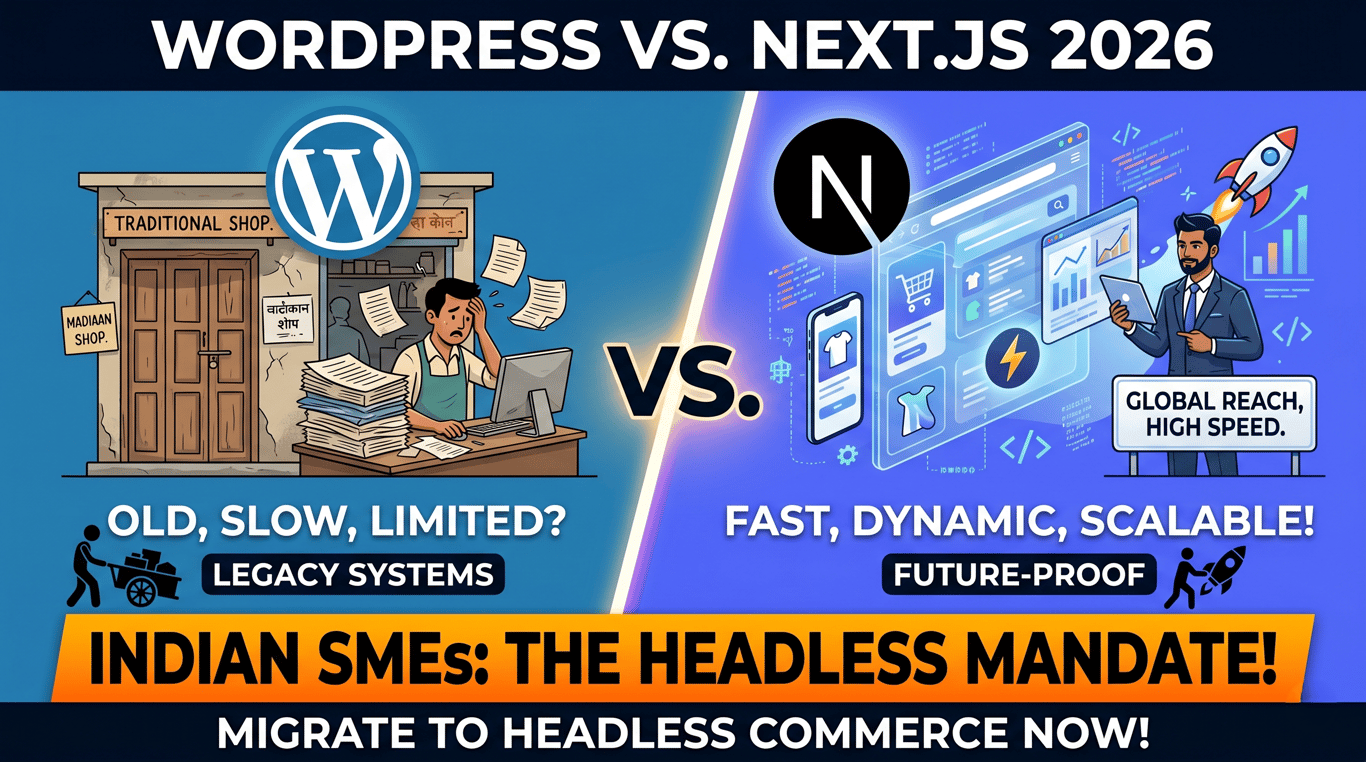
For over a decade, WordPress powered the ambitions of millions of Indian small and medium enterprises. It was accessible, affordable, and — for its time — adequate. But 2026 is not 2014. The competitive gap between a WordPress site and a Next.js-powered headless commerce experience has grown into a chasm. And Indian SMEs sitting on the wrong side of it are losing clients, rankings, and revenue every single day.
This article cuts through the noise. No generic comparisons, no filler. Just a direct, experience-backed breakdown of why the WordPress vs Next.js 2026 performance debate is no longer a debate — and why headless commerce development India is the only credible path forward for businesses serious about growth.
The WordPress Reality in 2026
WordPress still powers roughly 43% of the global web. That statistic gets cited endlessly as a validation. It shouldn't be. A large portion of that 43% is aging, plugin-bloated, poorly maintained infrastructure — exactly the kind of digital dead weight that tanks Core Web Vitals, buries search rankings, and sends potential clients directly to your competitors.
For Indian SMEs, the problem is compounded. Most WordPress deployments in the Indian market were built on shared hosting, purchased themes, and a fragile tower of plugins — WooCommerce, Yoast, Elementor, WPML, and a dozen others stacked on top of each other. Every plugin is a potential point of failure. Every update is a risk. Every additional page slows load time further.
Google's Page Experience signals are now deeply embedded in its ranking algorithm. Sites with poor Core Web Vitals — Largest Contentful Paint above 2.5 seconds, Cumulative Layout Shift above 0.1, Interaction to Next Paint above 200ms — face measurable ranking suppression. Most WordPress sites, without significant engineering investment, fail at least one of these benchmarks.
The result? Your business is invisible exactly when a buyer is searching for it.
What Is Next.js and Why Does It Change Everything?
Next.js is a React-based framework developed by Vercel. It enables developers to build websites that are fast by architecture — not fast because someone optimised images after the fact or installed a caching plugin and hoped for the best.
Here's what makes it structurally superior:
Static Site Generation (SSG) and Incremental Static Regeneration (ISR)
Next.js can pre-render pages at build time and serve them as static HTML from a CDN edge. When a user in Surat or Singapore requests your page, they get it from the nearest server node — not from a shared PHP server in some data centre. The difference in Time to First Byte alone can be 300–600ms. Over thousands of monthly visitors, this directly impacts your bounce rate and conversion pipeline.
Server-Side Rendering (SSR) When It Matters
For dynamic content — product listings, personalised dashboards, live inventory — Next.js handles server-side rendering with surgical precision. You get the SEO benefits of server-rendered HTML without the performance penalty of rendering everything dynamically.
The App Router and React Server Components
Next.js 14 and 15 introduced the App Router and React Server Components — a paradigm shift that allows developers to run components on the server and ship zero JavaScript to the browser for those components. For data-heavy pages common in B2B and e-commerce contexts, this is transformative.
WordPress vs Next.js 2026 Performance: The Numbers That Matter
Let's be direct about benchmarks. Independent performance audits comparing equivalent WordPress and Next.js deployments consistently show:
LCP (Largest Contentful Paint): WordPress average: 3.8–5.2 seconds. Next.js average: 0.9–1.6 seconds.
Total Blocking Time: WordPress average: 400–900ms. Next.js average: 0–80ms.
PageSpeed Insights Score (Mobile): WordPress typical range: 42–68. Next.js typical range: 88–99.
These are not edge cases. These are consistent patterns observed across real deployments. In a market where mobile traffic from tier-2 and tier-3 Indian cities now accounts for the majority of SME web traffic, mobile performance isn't optional — it's existential.
The Headless Commerce Architecture Advantage
When Indian SMEs hear "headless commerce," many assume it's an enterprise-only concept — something for Nykaa or Myntra, not a manufacturer in Kanpur or a services firm in Noida. That assumption is outdated and expensive.
Headless commerce development India is now accessible to businesses of any size. The architecture decouples the frontend (what users see and interact with) from the backend (where products, orders, and customer data live). This means:
1. Freedom of Frontend: Your website can be a blazing-fast Next.js experience while your commerce backend runs on Shopify, WooCommerce, or a custom API. You're not locked into the limitations of any single platform's theme system.
2. Content Flexibility: Integrate with headless CMS platforms — Wisp, Sanity, Contentful — without rebuilding your entire site. Your marketing team updates content; your Next.js frontend renders it instantly.
3. Composable Infrastructure: As your business scales, you add capabilities without architectural rebuilds. Payment gateway changes? API swap. New product categories? No theme conflict. Multilingual expansion? i18n routing at the framework level.
Why Indian SMEs Specifically Must Act Now
Indian SME websites face a unique convergence of pressures in 2026:
Competitive Escalation: Direct-to-consumer brands, funded startups, and multinational competitors all have engineering teams focused on web performance. SMEs without equivalent investment are competing on an uneven playing field — and losing.
Google's India Indexing Behaviour: Google's crawl budget is finite. Slow, bloated WordPress sites get crawled less frequently, meaning new content takes longer to index. For SMEs producing regular content or updating product listings, this is a direct revenue delay.
B2B Buyer Expectations: Indian B2B buyers — procurement managers, purchase heads, business owners — now hold consumer-grade expectations for web experience. If your site loads slower than a Zomato restaurant page, your credibility takes an immediate hit before you've said a single word.
The Export Opportunity Window: For SMEs targeting international buyers, website quality is the first filter. A buyer in Dubai, Berlin, or Toronto assesses your digital presence before they consider your product. A slow, outdated website signals a slow, outdated operation.
When to Upgrade WordPress to Next.js: A Practical Decision Framework
Not every WordPress site needs to be migrated immediately. But here are the signals that tell you it's time:
Your mobile PageSpeed score is consistently below 60
You're investing in paid ads or content marketing but your conversion rate remains flat
Your development team spends more time on plugin conflicts than on new features
You're targeting international or enterprise clients and losing to better-presented competitors
Your site has been running on the same theme and architecture for 3+ years
If three or more of these apply, the cost of staying on WordPress — in lost rankings, lost leads, and engineering debt — already exceeds the cost of migration.
What a Next.js Migration Actually Looks Like
A professional upgrade from WordPress to Next.js is not a copy-paste operation. It involves:
Content audit and migration strategy — identifying what content to carry forward, what to retire, and how to structure it in a headless CMS
Design system development — building a component library in React that replaces theme dependency with engineered UI
API integration layer — connecting to your commerce, CRM, and analytics infrastructure via clean API contracts
SEO continuity planning — preserving URL structures, redirects, metadata, and structured data without ranking drops during transition
Performance validation — Core Web Vitals benchmarking at every deployment stage
Done right, an SME can expect full migration in 6–12 weeks depending on content volume and integration complexity.
The Opportunity Cost of Waiting
Every month a business delays this migration is a month of compounding disadvantage. Pages that could be ranking aren't. Leads that could be converting aren't. Ad spend that could be performing at a higher ROAS isn't.
The Indian digital market in 2026 rewards technical excellence with compounding organic returns. The infrastructure you invest in today builds the rankings you benefit from for the next three to five years.
Final Word
The WordPress vs Next.js 2026 conversation is over for any SME that is serious about organic growth, lead generation, or international expansion. WordPress served its purpose. Next.js is the present and the foreseeable future.
Headless commerce development in India is no longer a luxury architecture. It is the baseline expectation for a business that wants to compete at scale — and Calsinas has built it for businesses exactly like yours.
If your website is still running on WordPress and you want to understand what a migration would cost, what it would unlock, and how fast it would pay for itself — let's talk.
Calsinas is a web development agency building high-performance, conversion-focused websites for Indian SMEs, manufacturers, and exporters. We specialise in Next.js development, headless commerce architecture, and B2B lead generation systems.