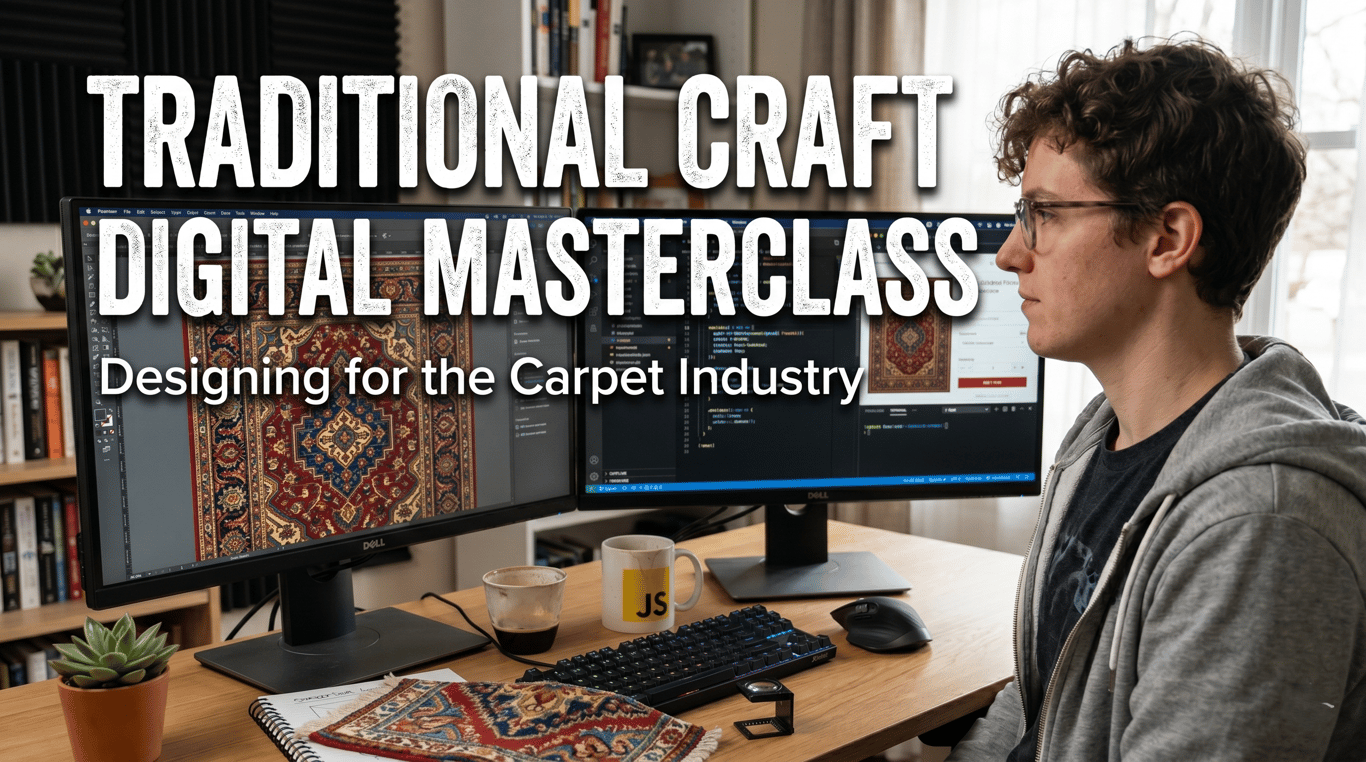
Bhadohi has been called the Carpet City of India for good reason. The district in eastern Uttar Pradesh produces handwoven carpets and rugs that find their way into luxury hotels in Dubai, design-forward apartments in New York, heritage properties in London, and high-end retail chains across Europe and North America. The craft tradition spans generations. The quality is internationally recognised. The export volumes are significant.
The digital presence of most Bhadohi carpet manufacturers is, by comparison, an embarrassment to the craft it represents.
A handwoven silk carpet that took three months to produce and retails internationally for $800 to $3,000 is being represented online by low-resolution photographs on a WordPress template designed for a generic product catalogue, loading in eight seconds on mobile, with no zoom capability, no texture detail, no weave count specification, and a contact form as the sole conversion mechanism.
The disconnect between the physical product and its digital representation is costing Bhadohi manufacturers direct buyer relationships, premium positioning, and the ability to compete on anything other than the lowest price an intermediary is willing to quote.
This is the complete UI/UX design for export business portfolios masterclass — written specifically for the carpet industry, with the Bhadohi context at its centre.
Why Carpet Selling Is a Uniquely Visual Commerce Challenge
Before the UI/UX framework, it is essential to understand what makes carpet digital commerce specifically demanding — and why generic e-commerce or product catalogue approaches consistently fail.
The Tactile Trust Problem
Carpet purchasing decisions — whether by individual buyers or commercial procurement managers — have historically been tactile experiences. A buyer touches the pile, evaluates the hand feel, holds the carpet to light to assess the sheen and colour depth, examines the back for knot density, and stretches the weave to test tension consistency.
None of this can be replicated digitally. But the degree to which a digital experience compensates for the absence of physical interaction determines whether an online buyer develops enough confidence to enquire, sample, or place an order.
A single flat JPEG photograph of a carpet on a white background develops almost no confidence. It shows colour (imprecisely, depending on screen calibration) and pattern (flatly, without depth). It communicates nothing about pile height, texture, sheen, border construction, or weave quality — the elements that determine whether a carpet is worth $200 or $2,000.
High performance digital catalog development for the carpet industry is fundamentally about solving the tactile trust problem — using visual technology, information architecture, and interaction design to create the closest possible approximation of physical evaluation.
The Customisation Communication Challenge
Most Bhadohi carpet manufacturers produce to order as much as to stock. Custom sizes, custom colour palettes, custom designs, private label production — these capabilities represent some of the highest-value commercial opportunities available to carpet manufacturers. They are also among the most difficult to communicate through conventional product catalogue interfaces.
A buyer who wants a custom 9x12 carpet in a modified traditional design with a specific colour palette adapted to their interior scheme needs to understand: Can you produce this? What is the process? What is the timeline? What is the minimum order? What proof-of-concept mechanism exists before full production commitment?
None of these questions are answerable through a standard product page. They require a digital experience architecture specifically designed for custom order communication — and most carpet manufacturer websites have nothing of the kind.
The Premium Positioning Paradox
A carpet manufacturer selling a hand-knotted silk carpet for $1,500 is competing in the premium segment of the global carpet market. Premium segment buyers have premium segment expectations — for product quality, yes, but equally for the purchasing experience. A buyer who has visited the websites of Stark Carpet, Mansour Modern, or Restoration Hardware does not lower their digital experience expectations when visiting a Bhadohi manufacturer's website. They apply the same premium experience standard and make a trust assessment accordingly.
The paradox is that Bhadohi manufacturers are often producing products of equivalent or superior quality to established premium brands at a fraction of the retail price — but their digital presence communicates the opposite quality differential. The premium product is packaged in a budget digital experience, and the buyer's trust assessment reflects the packaging, not the product.
Solving this paradox is the central UI/UX challenge for the carpet industry.
The Visual Architecture of a High-Performance Carpet Digital Catalogue
Website optimization for carpet manufacturers Bhadohi begins with visual architecture — the system of photographic, video, and interactive visual assets that carry the weight of communicating product quality in the absence of physical interaction.
Photography as the Primary Trust Infrastructure
Professional photography for carpet manufacturers is not a luxury investment — it is the foundational commercial infrastructure without which no other digital investment delivers full return. The photography system for a carpet digital catalogue requires multiple capture approaches:
Full-carpet flat-lay photography: The primary product view — a full carpet photographed from directly above on a clean, neutral background. This view communicates pattern, colour palette, and proportions accurately. It requires controlled lighting (typically studio softbox setups that eliminate harsh shadows while revealing pile depth) and a sufficiently large shooting area for larger carpet formats.
Styled room photography: Carpets photographed in context — placed in designed interior spaces that communicate scale, complement the carpet's aesthetic, and help buyers visualise the product in their own space. A traditional Persian-design carpet photographed in a warmly lit sitting room with classic furniture communicates its application and lifestyle positioning in a way that no flat-lay can achieve. A contemporary geometric design carpet in a minimalist Scandinavian interior communicates its design world with equal precision.
Detail and texture macro photography: Close-up photography of pile texture, border construction, knot backing, and colour transitions — the evidence shots that address the tactile trust problem most directly. A 3x magnified photograph of hand-knotted pile reveals craftsmanship quality that a full-carpet view cannot capture. Buyers who can see weave quality at macro level develop the physical product confidence that drives conversion.
Pile direction and sheen photography: Carpets shot from oblique angles to capture how the pile direction creates sheen variation — the light-catching quality that makes a silk carpet appear to change colour as you walk around it. This photographic technique communicates a product quality that is essentially invisible in flat-lay photography.
Scale reference photography: Carpets photographed with scale references — a piece of furniture, a human figure, a standard door — that communicate dimensions more intuitively than numerical specifications alone.
Video: The Closest Approximation to Physical Evaluation
Video capability for carpet digital catalogues is the highest-return visual investment after professional photography. Specific video content types deliver specific trust-building outcomes:
Pile movement video: A slow hand movement through carpet pile, filmed in close-up, communicates texture, density, and hand feel more effectively than any static photograph. Five seconds of pile movement video on a product page can replace dozens of static detail photographs.
Sheen rotation video: A carpet rotated slowly under controlled lighting, capturing how sheen shifts with pile direction changes. This video type communicates luxury carpet quality in a way that is simply impossible through static photography.
Weaving process video: Short-form documentation of the hand-weaving process — footage of weavers at work, the loom structure, the knotting process, the finishing stages — builds the craftsmanship narrative that justifies premium pricing and differentiates hand-made from machine-made product categories.
Customisation process video: Documentation of how a custom order moves from design brief to finished carpet — colour matching, design adaptation, weaving, finishing — builds buyer confidence in the custom order process and reduces the uncertainty that prevents many buyers from initiating custom enquiries.
The Page Architecture for Carpet Manufacturer Websites
Homepage: Premium Brand Positioning, Not Product Catalogue
The homepage of a carpet manufacturer website is not the place for a product grid. It is the place for premium brand positioning — establishing the quality, heritage, and craftsmanship credentials that justify the buyer's continued engagement.
A high-performing carpet manufacturer homepage architecture:
Hero section: Full-screen, high-resolution carpet imagery or video loop — not a product shot, but an evocative visual that communicates the aesthetic world the brand occupies. Typography that establishes heritage and craftsmanship credentials in a single headline.
Heritage narrative: A concise, well-crafted paragraph about the manufacturing tradition — not corporate history bullet points, but a genuine narrative about the craft, the region, and the expertise that makes the product exceptional.
Collection overview: Visual entry points to the major collection categories — Traditional, Contemporary, Customised, Silk, Wool — each with a single evocative image and a clear label. The homepage does not try to show everything; it curates the entry points.
Buyer trust signals: Export credentials, international client references (without naming confidential clients), country coverage, and certification indicators — positioned to answer the legitimacy question before it becomes an obstacle.
Customisation CTA: A prominent entry point to the customisation pathway — "Commission a Custom Carpet" or "Request Bespoke Design" — because custom orders are typically the highest-value commercial opportunity and should be surfaced prominently rather than buried in a contact form.
Collection and Category Pages: Discovery Architecture
Collection pages serve buyers who are browsing rather than searching for a specific product. The UI/UX design priorities for collection pages are discoverability and desire — helping buyers find products that suit their requirements while building desire through curated visual presentation.
Filtering architecture: Carpet buyers filter by multiple parameters simultaneously — pile material (wool, silk, cotton, viscose), construction type (hand-knotted, hand-tufted, flat-weave), design style (traditional, contemporary, geometric, botanical), colour palette, and size range. The filter system must be fast, visually clear, and non-destructive — a buyer should be able to add and remove filters without losing their position in the catalogue.
Grid versus editorial layout: A strict product grid communicates commodity. An editorial layout — mixing full-width feature products with grid items, incorporating lifestyle imagery between product blocks — communicates curation and premium positioning. For carpet manufacturers targeting the premium buyer segment, editorial layouts consistently outperform grids in engagement metrics.
Quick-view capability: Buyers browsing a collection want to evaluate multiple products rapidly without full page loads for each. A quick-view modal that loads the primary product images, key specifications, and a direct enquiry CTA allows rapid catalogue browsing while preserving the option for full product page deep-dives.
Product Pages: The Conversion Engine
Individual product pages are where buying decisions are made or abandoned. For carpet manufacturer websites, the product page must carry the full weight of physical product evaluation — and it must do so without overwhelming the buyer with information density.
Visual gallery architecture:
Primary image: full-carpet flat-lay
Secondary images: styled room, detail macro, pile texture, border closeup, reverse/backing
Video: pile movement, sheen rotation (where available)
Zoom capability: high-resolution zoom that allows buyers to examine texture detail at the level a physical inspection would permit
Specification presentation: The specification table for a carpet product page should cover:
Pile material and composition
Construction type and knot count (for hand-knotted)
Pile height
Total weight (GSM)
Available sizes (standard) and custom size capability
Colour palette reference codes
Country of origin and manufacturing location
Relevant certifications (Oeko-Tex, GoodWeave, fair trade where applicable)
Commercial information:
Minimum order quantity
Lead time for stock items
Lead time for custom orders
Sample availability and cost
Packing and shipping information
Customisation pathway: A clearly presented option for buyers to request customisation of the specific product — colour modification, size adjustment, design adaptation, private label — with a structured enquiry form that captures the necessary information to begin the customisation conversation.
The Customisation Interface: The Highest-Value Conversion Pathway
Custom carpet orders represent the highest average order values, the strongest buyer relationships, and the most defensible commercial positioning for Bhadohi manufacturers. Building a dedicated customisation interface — not just a contact form — is one of the highest-ROI digital investments available to carpet manufacturers.
A purpose-built customisation interface for a carpet manufacturer website guides the buyer through a structured brief-building process:
Step 1 — Base design selection: The buyer selects a base design from the manufacturer's portfolio as the starting point for customisation. This anchors the conversation and gives the manufacturer a clear brief reference.
Step 2 — Size specification: Standard size selector with a custom dimension input for non-standard requirements. Live preview showing the selected dimensions relative to a standard room context helps buyers visualise scale.
Step 3 — Colour palette specification: Colour selection tool — either from a predefined palette of available yarn colours or via a colour reference input (Pantone, RAL, or hex code for interior designer buyers) — that captures colour intent clearly enough for the manufacturer to provide an accurate sample proposal.
Step 4 — Quantity and timeline: Order quantity, required delivery date, and any specific commercial requirements (certificates, documentation, private label specifications).
Step 5 — Brief summary and submission: A structured summary of the customisation brief, presented for buyer review before submission, that generates a formatted enquiry the manufacturer's team can respond to with an accurate proposal.
This interface reduces the friction of initiating a custom order from "send us an email and explain what you want" — which most buyers are unwilling to do without a relationship — to a structured, guided process that most buyers will complete.
Performance Architecture for Global Carpet Buyers
High performance digital catalog development for the carpet industry has a specific technical challenge: carpet imagery is inherently data-heavy. High-resolution photographs of large, detailed carpets are large files. A product page with eight high-quality carpet images, managed naively, could require 40 to 80MB of image data — enough to make the page genuinely unusable on mobile connections.
Next.js solves this through its native Image component:
Automatic format optimisation: Images are served in WebP or AVIF format to supporting browsers — delivering equivalent visual quality at 30% to 50% of JPEG file size.
Responsive image serving: Different image resolutions are served based on the device's screen size and pixel density. A mobile user receives appropriately sized images; a 4K desktop monitor receives full-resolution imagery. No mobile user downloads a desktop-resolution image.
Lazy loading: Images below the fold are not loaded until the user scrolls toward them. The initial page load only fetches the images visible in the viewport — dramatically reducing above-the-fold load time.
Progressive loading: Images load progressively — beginning with a low-resolution placeholder and sharpening as the full image data arrives — rather than appearing as broken image placeholders until fully loaded. This maintains the visual integrity of the page during loading.
The combination of these techniques means a carpet product page with eight high-quality images can achieve an LCP under 1.5 seconds on mobile — competitive with any international luxury home furnishing website and dramatically better than the current standard for Indian carpet manufacturer websites.
The Buyer Trust Architecture: Converting Browsers to Enquirers
Visual excellence and performance attract and retain buyers. Converting browsing behaviour into commercial enquiry requires a specific trust architecture:
Export credentials and certifications: GoodWeave certification, Oeko-Tex Standard 100, fair trade certification, and export promotion council membership — presented as visual badges with explanatory tooltips — address the ethics and quality certification questions international buyers increasingly require answers to.
Production transparency: A dedicated "How We Make" section documenting the manufacturing process — from yarn sourcing through weaving to finishing — builds the craftsmanship narrative that justifies premium pricing and differentiates artisan production from mass-manufactured alternatives.
International client references: Countries and market segments served — "Supplied to luxury hotels in UAE, retail chains in Germany, interior designers in USA" — without necessarily naming confidential clients, communicate the scope of international experience.
Response time commitment: A visible, specific response time commitment — "We respond to all enquiries within 24 hours" — addresses the buyer concern that initial contact will disappear into a generic inbox. In competitive sourcing scenarios, perceived vendor responsiveness is a shortlisting criterion.
Mobile Experience for the Carpet Digital Catalogue
Over 55% of initial international buyer research on product categories including home furnishings now originates from mobile devices. A carpet digital catalogue that is not genuinely excellent on mobile — not just functional, but excellent — is failing more than half of its potential buyers at first contact.
Mobile-specific UI/UX considerations for carpet catalogues:
Full-screen image gallery on mobile: Product image galleries should be full-screen swipeable carousels on mobile — not small thumbnails that require precise tapping. The visual quality that communicates product excellence should be equally accessible on a 390px screen.
Pinch-to-zoom capability: Mobile buyers should be able to pinch-zoom on carpet images to examine texture detail — the same zoom capability available to desktop buyers through cursor hover. Most mobile-responsive carpet websites have no pinch-zoom capability.
Sticky enquiry CTA on mobile: A persistent "Request Sample" or "Get Quote" CTA, fixed to the bottom of the screen on product pages on mobile, ensures the conversion action is always one tap away regardless of scroll position.
Simplified customisation flow on mobile: The customisation interface should be rebuilt for mobile interaction — large touch targets, single-column step progression, and minimal text input requirements on the mobile version.
Final Word
Bhadohi's carpets are among the finest handwoven textiles produced anywhere in the world. They deserve digital representation that honours the craft, communicates the quality, and converts the international buyers who are actively searching for precisely what Bhadohi manufacturers produce.
UI/UX design for export business portfolios in the carpet industry is not a cosmetic exercise. It is the commercial infrastructure that determines whether a manufacturer's exceptional products reach the global buyers they deserve — or whether those buyers find a better-presented competitor instead.
Website optimization for carpet manufacturers Bhadohi is one of the highest-return investments available to any carpet business with serious export ambitions. The gap between current digital standards in the industry and the premium visual experience that international buyers expect is simultaneously the industry's biggest problem and its biggest opportunity.
Calsinas builds high-performance, visually excellent digital catalogues and export websites for Indian carpet manufacturers, textile exporters, and artisan product businesses. We understand both the product and the buyer.
Talk to us about your carpet business digital presence.
Calsinas is a web development and UI/UX design agency specialising in high-performance digital catalogues, export business websites, and conversion-focused web experiences for Indian manufacturers and exporters.