Every serious Indian export business understands the commercial logic of market diversification. Dependence on a single export destination — one country, one buyer, one currency — is a strategic vulnerability. Supply chain disruptions, policy changes, currency fluctuations, or a single relationship breakdown can devastate revenue overnight. The businesses that have built sustainable export operations spread risk across markets, geographies, and buyer relationships.
Most of those same businesses operate a single-language English website.
The contradiction is stark. A manufacturer who would never accept single-market export dependency accepts single-language digital dependency without question — effectively limiting their organic discoverability, their buyer trust infrastructure, and their conversion capability to the fraction of the global buyer universe that researches and purchases comfortably in English.
In 2026, multilingual website development for exporters is not an advanced digital strategy. It is the digital equivalent of diversifying export markets — a structural necessity for any business serious about global B2B growth.
And Next.js internationalized routing benefits make it the only credible technical architecture for building this capability properly.
The Commercial Case for Multilingual Export Websites
Before the technical architecture, the business case demands full examination. The numbers are compelling enough that any export business reading them should be uncomfortable with their current single-language position.
The English-Only Market Limitation
English is the working language of international trade. This is not in dispute. But "working language" does not mean "preferred research language." Buyers conduct due diligence research in their native language when that option is available — and when it is not, they conduct it in English with measurably lower trust and engagement.
Consider the buyer segments most relevant to Indian exporters:
Germany: The largest economy in Europe and a major destination for Indian industrial goods, handicrafts, textiles, and engineering products. German buyers — particularly in the Mittelstand SME sector that drives a significant share of import purchasing — conduct procurement research primarily in German. A website presenting in German to a German buyer communicates respect, market commitment, and operational sophistication. The same content in English communicates that the supplier has not prioritised this market specifically.
France: France imports significant volumes of Indian textiles, home furnishings, and specialty foods. French B2B buyers show among the lowest English-language research preference of any major European economy. A French-language website for an Indian textile exporter is not a translation exercise — it is access to a buyer segment that is currently unreachable.
Arabic-speaking markets (UAE, Saudi Arabia, Kuwait, Oman): The Gulf Cooperation Council represents one of the highest-value export destinations for Indian handicrafts, construction materials, textiles, and food products. Arabic-language content — particularly for product categories with cultural or religious relevance — directly increases buyer trust and conversion. Gulf-based importers buying home decor, furnishings, or gift items for local retail distribution respond measurably better to suppliers who demonstrate cultural awareness through language investment.
Spanish: Latin American markets — Mexico, Colombia, Chile, Peru — are emerging high-growth destinations for Indian exporters. Spanish-language content opens a buyer universe of 500 million native speakers, the overwhelming majority of whom conduct purchasing research in Spanish.
Japanese and Korean: For precision manufacturing, textile, and specialty product exporters targeting East Asian markets, Japanese and Korean language capability is a near-prerequisite for serious vendor consideration. Japanese procurement culture specifically prioritises supplier commitment and relationship investment — a Japanese-language website communicates both.
The arithmetic is direct: custom web development for global B2B in multiple languages multiplies the addressable buyer universe with each language added. Each language is a new organic search surface, a new trust infrastructure, and a new direct conversion channel into a distinct buyer market.
Why Most Multilingual Website Approaches Fail
The recognition that multilingual content is commercially valuable is not new. Export businesses have attempted multilingual web presence for years. Most of those attempts have failed to deliver the expected commercial returns — and the reasons are instructive.
The Translation-Overlay Failure
The most common approach to multilingual websites is a translation overlay — tools like Google Translate widgets or Weglot plugins applied to an existing single-language website. The logic is understandable: it is fast and inexpensive. The commercial reality is that it is nearly useless.
Translation overlays produce machine-translated content that native speakers identify immediately as non-native. The trust signal is negative — a buyer reading machine-translated German copy about your manufacturing capability is receiving active evidence that you did not invest in communicating with them properly. The experience says "we know you exist, but not enough to write for you specifically."
Translation overlays also produce zero SEO benefit. Google does not index overlay-translated content as distinct language pages. The German buyer searching in German finds no organic entry to your website — the overlay only activates after a German-language user has already found and visited your English site through a non-organic channel.
The Static Multi-Language Failure
Some businesses build true multi-language websites — separate German, French, and Arabic page sets with genuine translated and localised content. This approach delivers real SEO and trust benefits. But when implemented on WordPress or static HTML architecture, it creates unsustainable maintenance infrastructure.
Every time a product is added, a price changes, or content is updated, the change must be replicated across every language version manually. For a business with 200 products and 5 language versions, this means 1,000 manual page updates for a single product range refresh. In practice, language versions fall out of sync. German pages show outdated product information. Arabic pages have broken images. The trust signal that the multilingual investment was meant to build begins actively eroding.
The Hreflang Misimplementation Failure
Even businesses that invest properly in multilingual content frequently fail at the technical SEO implementation. Hreflang tags — the HTML attributes that tell Google which language version of a page to serve to which audience — are among the most commonly misimplemented SEO elements on the web.
Incorrect hreflang implementation means Google either ignores the language signals entirely (serving English content to German searchers) or creates duplicate content penalties that suppress rankings across all language versions. The investment in translated content delivers no organic performance return because the technical infrastructure that would activate that content in international search results is broken.
Next.js internationalized routing solves all three of these failure modes at the architectural level.
Next.js Internationalised Routing: The Technical Architecture
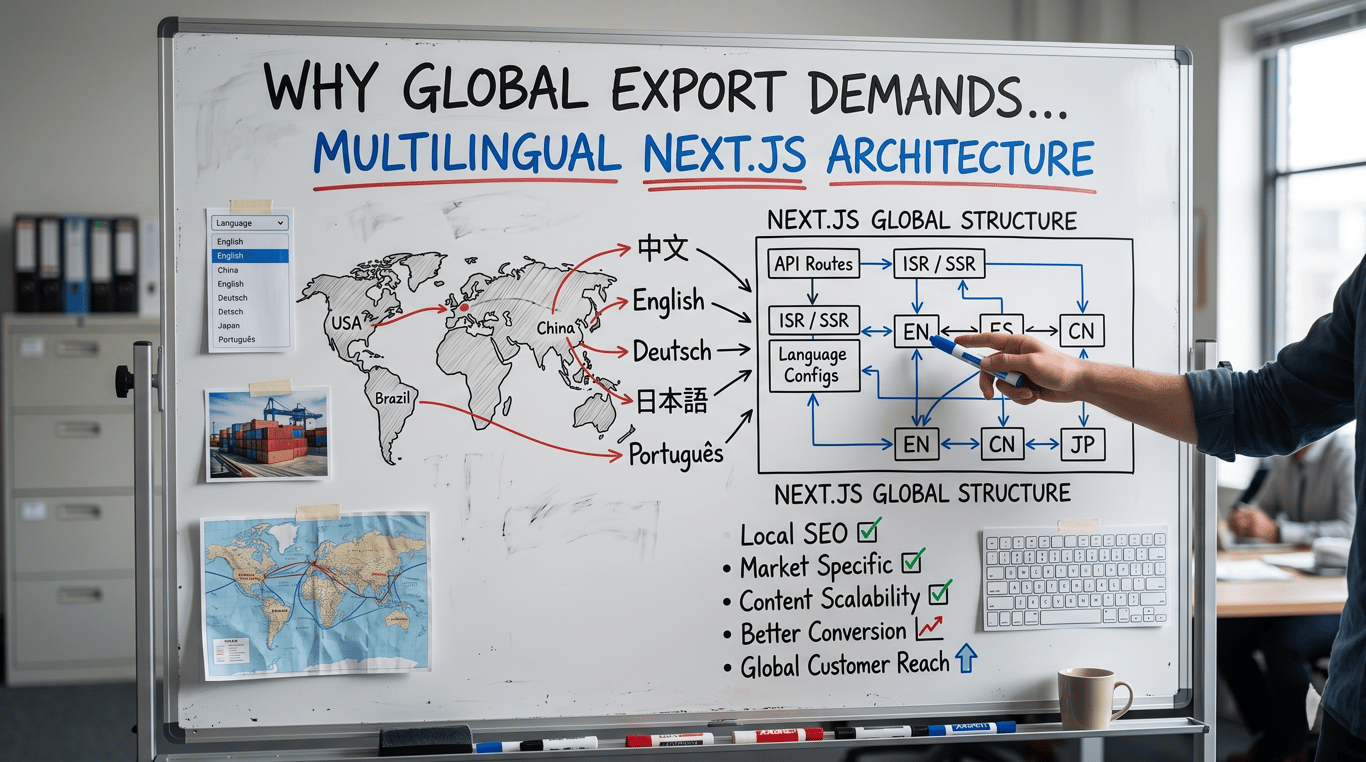
Next.js has native internationalisation support built into its routing architecture — not bolted on as a plugin or overlay, but integrated as a first-class framework feature. Understanding what this means in practice explains why it is the correct choice for export business multilingual infrastructure.
The i18n Routing Configuration
Next.js i18n routing is configured in a single next.config.js declaration:
module.exports = {
  i18n: {
    locales: ['en', 'de', 'fr', 'ar', 'es'],
    defaultLocale: 'en',
    localeDetection: true,
  },
}
This configuration activates automatic locale-based routing across the entire application. A German browser visiting your domain is automatically served the /de/ URL path. An Arabic browser receives /ar/ with correct RTL text direction handling. A French buyer in Lyon receives /fr/ — with full SEO-indexed French content that ranks independently in French Google search.
No plugin. No overlay. No separate codebase for each language. One Next.js application, one deployment, five languages — each fully indexed, each serving the correct content to the correct audience automatically.
Automatic Hreflang Generation
Because language routing is handled at the framework level, hreflang attributes are generated programmatically and correctly for every page in every language. The most common cause of multilingual SEO failure — manual hreflang misimplementation — is eliminated by architecture.
Google receives clean, correct language signals for every page. German content ranks in German search. Arabic content ranks in Arabic search. French content ranks in French search. Each language version operates as an independent organic search surface with no cross-language contamination or duplicate content penalty.
Headless CMS Integration for Translation Workflow
The maintenance nightmare of static multi-language websites — manual content synchronisation across language versions — is solved through headless CMS integration. With a CMS like Sanity, Contentful, or Wisp configured for multi-locale content management, the workflow becomes:
Content is created in the primary language (English)
Translation workflow is triggered — either through professional human translation or AI-assisted translation with human review
Translated content is published to the CMS locale field
Next.js fetches the correct locale content for each page render automatically
A product added to the English catalogue appears in the German, French, and Arabic catalogues once translated — without any developer intervention or manual page duplication. Content stays synchronised across language versions by architecture, not by manual process.
RTL Language Support
Arabic and other right-to-left languages present a specific implementation challenge that Next.js handles cleanly through its CSS-in-JS and styling architecture. RTL layout — mirror-image text direction, reversed navigation, adjusted component layouts — is implemented as a locale-aware style variant rather than a separate design system. Arabic users receive a fully correct RTL experience without a separate codebase or design file.
For Indian exporters targeting Gulf markets, this is commercially significant. An Arabic website that renders in LTR because the developer "did not get to RTL support yet" communicates the same carelessness as a machine-translated overlay. Full RTL support in Arabic is the baseline for credible Gulf market digital presence.
The SEO Architecture of Multilingual Next.js for Exporters
The organic search performance of a well-implemented multilingual Next.js export website is multiplicative, not additive. Each language version is an independent organic search surface that builds authority and ranking positions independently in its target market's search index.
Language-Specific Keyword Research
Effective multilingual SEO for export businesses begins with language-specific keyword research — not translation of English keywords into other languages, but original research into how buyers in each target market actually search for your product category.
German procurement buyers searching for brass decorative items use different query structures than English-language buyers. French interior design buyers searching for Indian textile suppliers use different terminology and intent signals than their British counterparts. Arabic-speaking Gulf buyers searching for Indian handicraft wholesalers use search patterns shaped by their specific commercial context.
Language-specific keyword research identifies these query patterns and informs the page content, meta data, and heading structure for each language version — ensuring that pages rank for the queries buyers in each market actually use, not for translated approximations of English-market queries.
Country-Code vs. Subdirectory vs. Subdomain Architecture
For export businesses, the URL structure choice for multilingual content has significant SEO implications:
Country-code top-level domains (ccTLDs): yourcompany.de, yourcompany.fr — strongest geographic signal to Google, but requires separate domain registration and hosting for each market. High maintenance overhead. Recommended only for businesses with major, long-term commitment to specific markets.
Subdirectories: yourcompany.com/de/, yourcompany.com/fr/ — consolidates all domain authority into a single root domain, is fully supported by Next.js i18n routing, and requires no additional domain infrastructure. This is the recommended architecture for most Indian export businesses. All organic authority from backlinks, brand searches, and historical performance accrues to the primary domain and benefits all language versions.
Subdomains: de.yourcompany.com, fr.yourcompany.com — treated by Google similarly to separate domains, splitting authority. Not recommended.
Next.js native i18n routing implements the subdirectory architecture by default — the commercially and technically optimal choice for export businesses, activated without custom configuration.
International Link Building
Each language version of your export website benefits from language-specific link building — inbound links from German trade publications, French industry directories, Arabic business portals, and Spanish-language export resources. These links signal geographic authority to Google and drive direct referral traffic from relevant buyer audiences in each market.
A German-language article about Indian handicraft quality standards published on a German interior design trade website, linking to your German-language product pages, delivers both a high-authority backlink and direct exposure to German buyers in your target category. This type of market-specific authority building is only possible when you have substantive German-language content worth linking to.
Localisation Beyond Translation: What Serious Export Websites Do Differently
The difference between a translated website and a localised website is the difference between a document and a conversation.
Translation changes words. Localisation changes context — adapting not just language but cultural references, commercial norms, trust signals, imagery, and commercial terms to the specific expectations of each target market.
Market-Specific Commercial Terms
German buyers expect to see product specifications in metric units with DIN standard references. US buyers expect Imperial measurements with ASTM references. Gulf buyers expect pricing transparency about VAT-exclusive pricing and standard payment terms in their commercial context.
A localised product page for German buyers presents specifications in the format German procurement managers use. A localised page for Gulf buyers presents commercial terms in the format Gulf importers expect. This level of adaptation communicates market knowledge that builds buyer confidence before a single enquiry has been exchanged.
Currency and Pricing Display
Displaying indicative pricing in local currencies — or at minimum confirming that pricing is available in USD, EUR, AED, or GBP — removes the currency ambiguity that causes international buyers to abandon product evaluation before enquiring.
Next.js dynamic rendering supports currency display based on locale detection, allowing export websites to show indicative pricing in the buyer's local currency without requiring manual price list management for each market.
Market-Specific Social Proof
A testimonial from a German client carries more weight for a German buyer than a testimonial from a US buyer. A case study documenting supply of a Gulf retail chain is more relevant to a Gulf-based importer than a case study from a European retailer. Localised social proof — testimonials, client logos, case studies, and reference markets — presented in each language version should feature buyers from, or relevant to, that market specifically.
Implementation Roadmap for Export Business Multilingual Development
Phase 1 — Foundation (Weeks 1–6): English-language website built on Next.js with i18n routing architecture configured from the start. Content management system configured for multi-locale support. Hreflang infrastructure validated in Google Search Console.
Phase 2 — Priority Market Launch (Weeks 7–14): First non-English language version launched — typically German or Arabic depending on the exporter's primary target market. Professional translation with localisation review. Market-specific keyword research informing page content. Google Search Console property configured for the new language version.
Phase 3 — Market Expansion (Months 4–9): Additional language versions launched sequentially. Market-specific content programmes initiated in each language. Language-specific link building outreach commenced.
Phase 4 — Compound Growth (Month 10+): Performance data from each language version informs content expansion priorities. High-performing product categories receive deeper content treatment in high-conversion languages. Paid media in target markets leverages organic content infrastructure for landing page quality and relevance scoring.
The Competitive Moat of Early Multilingual Investment
There is a compounding advantage to early multilingual SEO investment that makes timing consequential. Organic authority — the domain-level and page-level trust signals that determine search rankings — accumulates over time. A German-language product category page published today will have 12 months of authority accumulation by the time a competitor decides to build their German-language presence next year.
The export businesses that invest in multilingual Next.js architecture in 2026 are building a competitive moat that will be significantly more expensive for latecomers to close. The rankings they earn in German, French, Arabic, and Spanish search results will compound in value — generating more traffic, more backlinks, and more buyer relationships — with no proportionate increase in ongoing cost.
Final Word
Multilingual website development for exporters is the digital equivalent of opening offices in your target markets. It signals commitment, communicates respect, and dramatically expands the addressable buyer universe for every product you manufacture.
Next.js internationalized routing makes this expansion technically clean, commercially scalable, and SEO-effective in a way that no other web architecture currently matches. It is not an advanced option for large enterprises — it is the correct architecture for any export business that is serious about global direct buyer acquisition.
Calsinas builds multilingual Next.js websites for Indian exporters — from architecture planning and CMS configuration through professional translation workflow and international SEO programme management.
If your export business is still presenting to the world in a single language, you are not speaking to the full buyer universe your products deserve.
Let's build the multilingual presence your export business needs.
Calsinas is a web development agency specialising in multilingual Next.js architecture, international SEO, and custom web development for global B2B export businesses based in India.