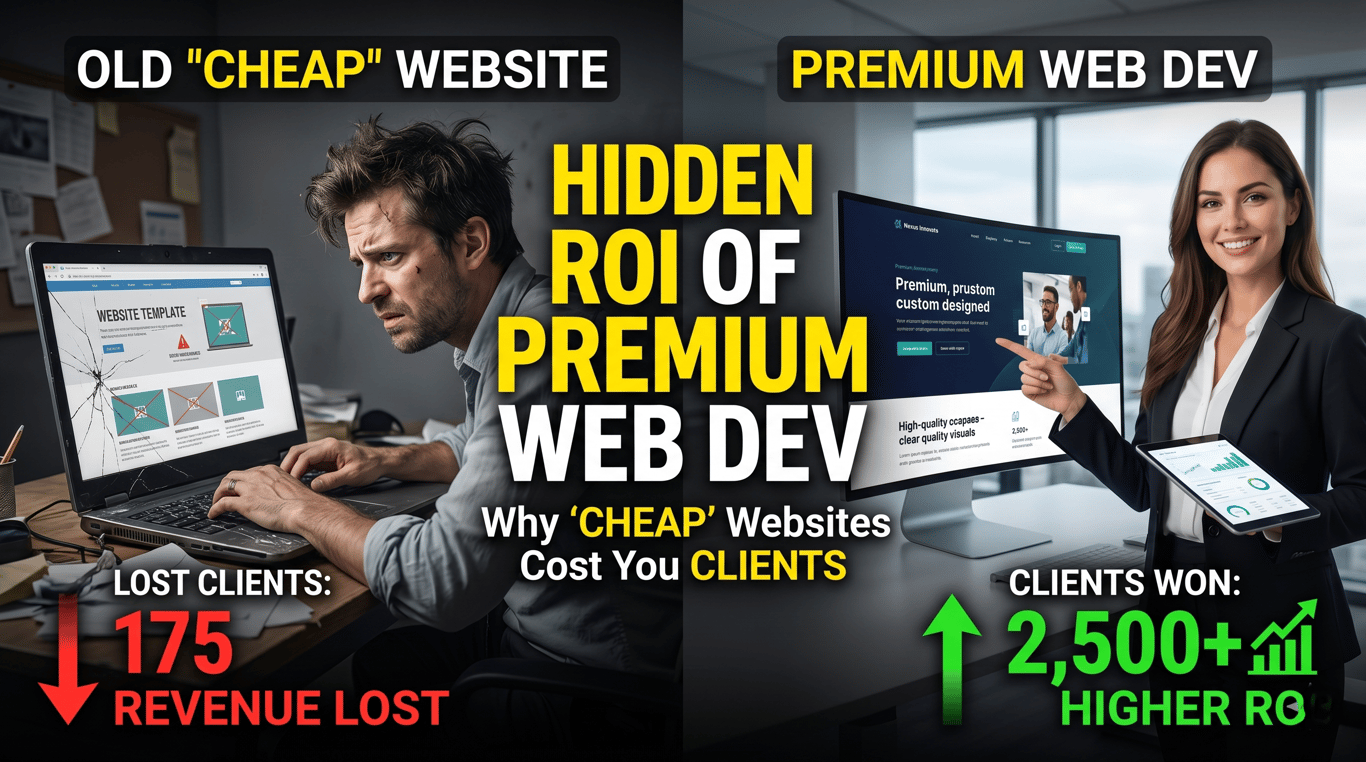
Every week, a business owner somewhere in India makes what feels like a financially responsible decision: they hire a freelancer or a budget agency to build their website for ₹12,000 to ₹40,000. The site goes live. It has pages. It has a contact form. It technically works.
And then, quietly, invisibly, it starts costing them money.
Not in maintenance invoices. Not in obvious failures. In the clients who visited, assessed, and left. In the enterprise leads who found a competitor's site more credible. In the ad spend that drove traffic to a page that couldn't convert. In the years of compounding organic growth that never happened because the site was structurally incapable of ranking.
This is the hidden cost of cheap web development — and for Indian SMEs and startups, it is one of the most expensive decisions they make without ever seeing the invoice.
The False Economy of Budget Web Development
Let's start with a number that feels safe: ₹20,000 for a website. Compare that to ₹2,50,000 for a professionally engineered Next.js website from a specialist agency. On the surface, the budget option saves ₹2,30,000. That framing is the trap.
The correct question is not "how much does each option cost to build?" The correct question is "how much revenue does each option generate — or fail to generate — over its lifetime?"
A website is not an expense. It is a sales infrastructure investment. The return on that investment depends entirely on the quality of the infrastructure. And the website redesign ROI for small business math, when done honestly, almost always points in the same direction.
What "Cheap" Actually Buys You
A budget website in the Indian market typically delivers:
A purchased theme — a pre-built visual template used by thousands of other businesses, impossible to differentiate on, and built on CSS and JavaScript that no one has optimised for your specific performance requirements.
A WordPress or website-builder backend — technically functional, but architecturally limited in performance ceiling, SEO potential, and scalability.
No conversion strategy — the page layouts, copy hierarchy, and CTA placement are dictated by the theme designer, not by your buyer's psychology or your sales funnel logic.
No technical SEO foundation — schema markup, proper heading hierarchy, canonical tags, sitemap architecture, and page speed infrastructure are rarely included in budget builds.
No post-launch ownership — the freelancer who built it has moved on. Updates break things. Plugins conflict. Security vulnerabilities accumulate. You are now the accidental systems administrator of a fragile digital asset.
Each of these gaps has a direct revenue consequence. Together, they create a website that looks like a sales tool but functions like a liability.
The Real Cost of a Cheap Website: A Framework
To understand the cost of Next.js website development India versus a budget alternative, you need to think in terms of lost revenue — not just build cost.
Lost Organic Traffic Value
A professionally built Next.js website with proper technical SEO, passing Core Web Vitals, and a structured content architecture can realistically achieve first-page rankings for 15 to 40 target keywords within 6 to 12 months of launch, depending on competition and content investment.
A budget WordPress site on shared hosting, with no technical SEO foundation, might rank for 2 to 5 lower-intent terms in the same period — if the owner actively maintains it.
If each ranked keyword drives 200 monthly visitors and your service average contract value is ₹1,50,000, the difference between ranking for 5 keywords versus 25 keywords represents 4,000 additional monthly visitors. At a 2% conversion rate, that is 80 additional leads per month. At a 15% close rate, that is 12 new clients per month. At ₹1,50,000 average contract value, that is ₹18,00,000 per month in pipeline — from organic traffic alone.
The budget website did not save ₹2,30,000. It cost you access to a ₹18,00,000 monthly pipeline.
Lost Paid Traffic ROI
Many SMEs run Google Ads or Meta campaigns driving traffic to their website. Budget websites convert paid traffic at 1% to 2% on average. A professionally designed, conversion-optimised Next.js landing page converts at 4% to 7% for equivalent traffic.
If you are spending ₹50,000 per month on paid traffic at ₹50 per click, you are buying 1,000 visitors. At 1.5% conversion, you get 15 leads. At 5% conversion on the same spend, you get 50 leads. The premium website just tripled your paid media ROI without an additional rupee of ad spend.
Lost Enterprise and B2B Credibility
This cost is harder to quantify but the most devastating in practice. Enterprise procurement teams, international buyers, and high-value B2B clients do not just use your website to find contact information. They use it to make trust assessments.
A website that looks like a template, loads slowly, lacks case studies presented with design care, and has no clear demonstration of technical credibility sends a single message: this company does not invest in its own excellence. Why would they invest in mine?
The affordable web design company hidden costs show up most brutally at the top end of your client value spectrum — exactly where you most want to win.
What Premium Web Development Actually Delivers
When Calsinas builds a website on Next.js for an Indian SME or startup, the investment covers fundamentally different deliverables than a budget build:
Conversion Architecture: Every page is designed around a specific conversion goal. The homepage's job is not to look impressive — it is to move a specific type of visitor toward a specific next action. The services page is structured to answer the exact objections a mid-funnel buyer has. The contact page removes every possible friction between intent and submission.
Technical SEO Infrastructure: Schema markup is implemented for the business type and content. Canonical tags prevent duplicate content dilution. XML sitemaps are structured for crawl efficiency. Page speed is validated against Core Web Vitals thresholds before launch, not after.
Performance by Architecture: Next.js static generation means pages load in under 1.5 seconds on mobile without caching plugins, CDN add-ons, or ongoing optimisation overhead. This performance is structural — it does not degrade as you add content.
Scalable Component System: Rather than a theme with limited customisation, a professionally built Next.js site uses a design system of reusable React components. Adding a new service page, a case study, or a campaign landing page takes hours, not days, and maintains design consistency automatically.
Content Management Integration: With a headless CMS like Wisp integrated into the stack, your marketing team controls content updates without developer involvement — and without the security vulnerabilities and plugin conflicts of WordPress.
The Website Redesign ROI Calculation for Small Business
Here is a simplified ROI framework any business owner can apply to their own situation:
Step 1 — Establish your current website's monthly lead volume Check Google Analytics or your CRM. How many leads per month does your current site generate through organic and direct traffic?
Step 2 — Establish your average client value What is the average contract or order value of a client won through digital channels?
Step 3 — Estimate realistic improvement from a premium rebuild Conservative estimates based on real migration data: 2x to 4x improvement in organic lead volume within 12 months. 2x to 3x improvement in paid traffic conversion rate immediately post-launch.
Step 4 — Calculate the payback period If your premium website costs ₹2,50,000 and generates 10 additional leads per month at a 20% close rate with ₹1,00,000 average contract value, it generates ₹2,00,000 in additional monthly revenue. Payback period: 6 weeks.
This is not a theoretical exercise. This is the math that premium web development clients consistently experience when they make the move from budget to engineered infrastructure.
The Startups That Cannot Afford to Get This Wrong
For Indian startups in particular, the cost of Next.js website development India framing needs to shift entirely. A startup's website is not a marketing asset — it is a fundraising asset, a talent acquisition asset, and a customer trust asset simultaneously.
Investors assess digital presence as a proxy for execution quality. Engineers evaluating job offers look at a startup's product and public-facing web presence as indicators of technical culture. Early customers deciding between an established player and a newer entrant use web experience as a trust signal.
A startup that launches with a budget website is not saving money on marketing. It is starting every conversation — with investors, talent, and customers — from a position of credibility deficit.
When to Redesign: The Signals You Cannot Ignore
The website redesign ROI for small business calculation becomes undeniable when you see:
Monthly organic sessions plateauing or declining despite content investment
Paid campaigns hitting frequency caps without conversion improvement
Sales team reporting that prospects "checked out the website but didn't seem impressed"
Enterprise or export inquiries not progressing past initial interest
Mobile PageSpeed score consistently below 65
No leads generated from organic search in the last 90 days
If three or more of these are true, your website is not a neutral asset. It is an active constraint on your growth — and the cost of redesigning it is almost certainly lower than the cost of the revenue it is currently blocking.
The Honest Conversation About Investment
Premium web development in the Indian market from a specialist Next.js agency starts at approximately ₹1,50,000 for a focused SME website and scales based on complexity, integration requirements, and content volume. That number feels significant in isolation.
In the context of what it unlocks — consistent organic lead generation, credible B2B positioning, scalable paid media performance, and a technical foundation that compounds in value over years — it is one of the highest-return investments an Indian SME or startup can make in its first three years of operation.
The cheap website was never really cheap. It was just billing you in a currency you couldn't see on your balance sheet — opportunity.
Final Word
The businesses winning in Indian B2B and SME markets in 2026 are not the ones with the biggest budgets. They are the ones that made early, intelligent infrastructure decisions — including the decision to build their digital presence on a foundation capable of performing.
Your website is your best salesperson or your worst one. The difference between those two outcomes is almost entirely a function of the investment behind it.
If you are ready to understand what a premium Next.js website could do for your lead generation and client acquisition — not in theory, but with numbers specific to your business — let's have that conversation.
Calsinas builds high-performance, conversion-focused Next.js websites for Indian SMEs and startups. We do not build cheap websites. We build websites that pay for themselves.