The Indian EdTech market is projected to reach $10 billion by 2025 and continue accelerating through the decade. Behind that headline number is a quieter, more uncomfortable reality: most e-learning platforms built on generic templates, off-the-shelf LMS solutions, and cobbled WordPress plugins are failing their users — and failing their operators.
Student dropout rates on underpowered platforms run between 60% and 85%. Not because the content is poor. Because the interface is frustrating, the performance is inconsistent, and the experience communicates — through every sluggish interaction — that the platform was not built for serious learning.
The institutions and EdTech businesses that are growing in 2026 share a common infrastructure decision: they invested in custom web app development for e-learning built on React. They did not buy a template. They engineered an experience.
This article breaks down exactly why React website development for educational platforms is the technical and strategic foundation every serious e-learning operator needs — and what that looks like in practice.
The Problem with Generic LMS Platforms
Before establishing what custom React development delivers, it is worth being precise about what generic solutions fail to deliver.
The dominant off-the-shelf e-learning platforms — Moodle, Teachable, Thinkific, and their Indian-market equivalents — are designed for the median use case. They are built to accommodate the broadest possible range of users, content types, and institutional structures. That breadth is their commercial advantage and their functional limitation simultaneously.
For an EdTech startup targeting a specific learner segment — say, competitive exam preparation for Class 11 and 12 students, or professional upskilling for mid-career engineers — the median use case is irrelevant. What matters is the specific interaction patterns, content structures, progress mechanisms, and motivational triggers that work for that specific audience.
Generic platforms cannot deliver specificity. They deliver configurability within fixed limits. And those limits are where engagement goes to die.
The performance ceiling is structural. Moodle in particular, and most PHP-based LMS platforms, carry architectural weight that manifests as slow load times, poor mobile performance, and Core Web Vitals scores that would embarrass any modern frontend engineer. For learners on mobile connections in tier-2 Indian cities — a massive and growing segment of the EdTech addressable market — these performance failures translate directly into abandoned sessions.
The UI flexibility ceiling is real. You can change colours and upload a logo. You cannot redesign the information architecture. You cannot build a custom progress visualisation. You cannot implement a spaced repetition interface that matches your specific pedagogical approach. You are working inside someone else's product decisions — forever.
Why React Is the Correct Architecture for E-Learning
React website development for educational platforms solves the core problems of generic LMS platforms at the architectural level, not through configuration.
Component-Based Architecture Maps to Learning Structure
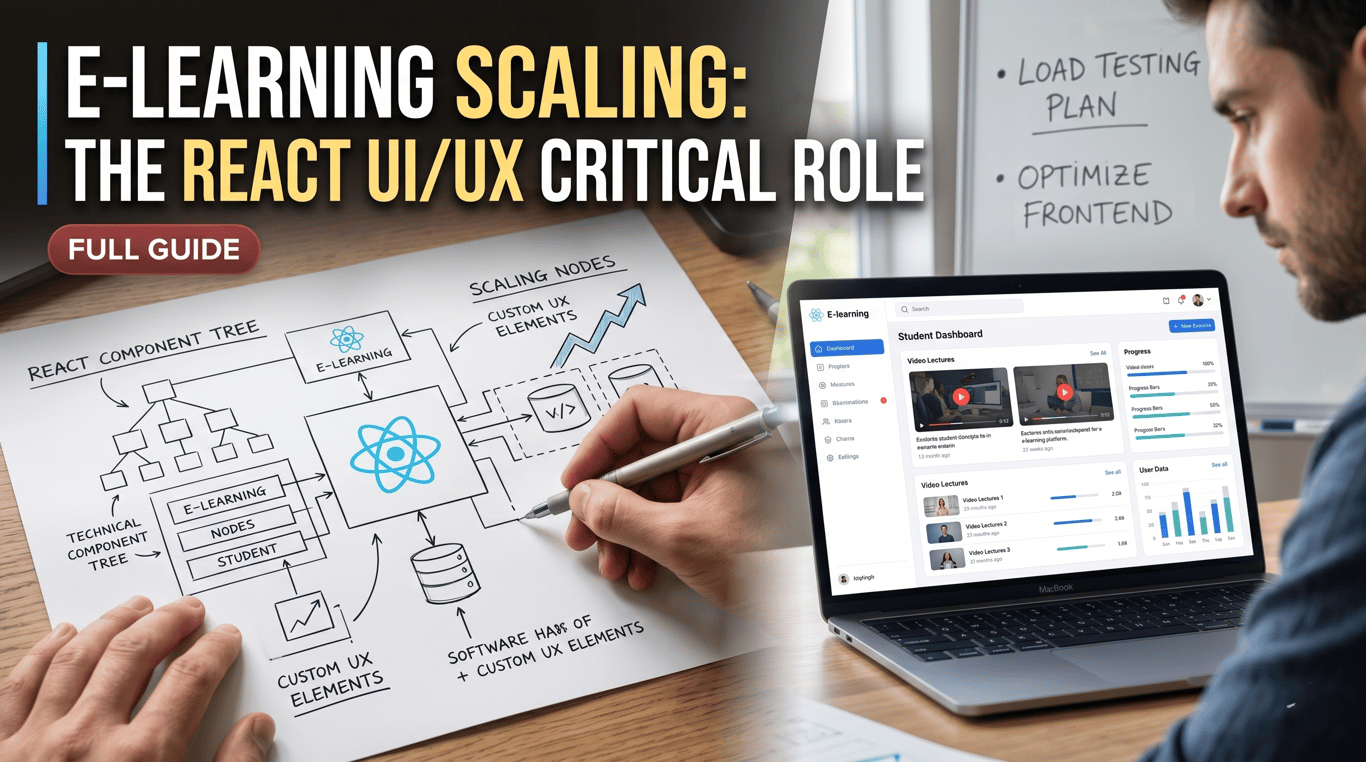
Educational content has natural hierarchy: courses contain modules, modules contain lessons, lessons contain content blocks — video, text, quiz, interactive exercise. React's component architecture maps directly onto this hierarchy. Each content type becomes a purpose-built component, designed and optimised for its specific function.
A video component handles buffering states, progress tracking, playback speed controls, and completion detection. A quiz component handles answer state, scoring logic, explanatory feedback, and retry mechanics. A progress component visualises completion across a course tree in real time.
Each component is developed once and reused consistently throughout the platform. When a design update is needed, it propagates everywhere. When a performance improvement is made to the video component, every lesson benefits instantly.
This is categorically different from configuring modules inside a monolithic LMS. This is engineering a learning system from first principles.
Real-Time Interactivity Without Page Reloads
Traditional server-rendered platforms reload the page — or significant portions of it — for every meaningful interaction. A student submits a quiz answer. The page reloads. The course navigation reloads. The progress bar reloads. Every reload is a disruption to the learning state — the cognitive flow that effective education depends on.
React's virtual DOM and state management architecture means interactions are handled client-side. A student answers a question, receives immediate feedback, and sees their progress update — all without a single network round trip for page content. The experience feels like a native application, not a website.
For platforms using Next.js integration for student portals, this interactivity coexists with server-side rendering for initial page loads — giving you the SEO and performance benefits of SSR alongside the interaction quality of a full React application. This combination is not achievable with traditional LMS architecture.
Adaptive and Personalised Learning Paths
The most effective e-learning experiences are not linear. They adapt based on learner performance, pace, and engagement patterns. A student who demonstrates mastery of foundational concepts should be accelerated. A student struggling with a specific topic should receive additional practice material before progressing.
Implementing adaptive learning logic in a generic LMS means working against the platform's fixed content sequencing. In a custom React application, adaptive logic is a feature — designed into the state management layer, connected to the content delivery API, and expressed through dynamic UI states that respond to learner data in real time.
This is the difference between a platform that delivers content and a platform that delivers learning.
The UI/UX Principles That Drive E-Learning Engagement
Custom web app development for e-learning is not just a technical decision. It is a pedagogical one. The UI/UX of a learning platform directly determines whether students engage, persist, and ultimately succeed.
Cognitive Load Management
Learning is cognitively demanding. Every element of the interface that requires mental processing — navigation decisions, visual noise, unclear progress indicators, inconsistent interaction patterns — draws cognitive resources away from the learning content itself.
Custom React UI/UX is designed around cognitive load minimisation. Navigation is predictable and peripheral. Progress indicators are ambient — always visible but never demanding attention. Content presentation follows a consistent visual grammar that learners internalise quickly, freeing cognitive capacity for the material itself.
Generic templates fail here because they are designed to showcase features, not to support cognition. Feature-rich interfaces and learning-optimised interfaces are often direct opposites.
Progress Visibility and Motivational Architecture
Completion rates on e-learning platforms are directly correlated with progress visibility. Learners who can see where they are in a course, how far they have come, and what concrete next step awaits them continue at significantly higher rates than those on platforms where progress is opaque or buried.
Custom React development allows progress architecture to be designed as a first-class feature. A course completion dashboard that shows streak data, module progress, quiz scores, and time-to-completion estimates — built as a purpose-designed React component — is a motivational instrument as much as an informational one.
Mobile-First Learning Experience
Over 70% of Indian EdTech consumption happens on mobile devices. The implications for platform design are total. A mobile-first React learning platform is not a desktop website with responsive CSS. It is a fundamentally different interaction architecture — thumb-zone navigation, swipe-based content progression, optimised video delivery for variable connection quality, and offline capability through Progressive Web App implementation.
Generic LMS platforms offer "mobile responsive" versions that are, in practice, compromised desktop experiences on smaller screens. A custom React PWA delivers a mobile experience that competes with native applications — without requiring app store distribution or separate development investment.
Next.js Integration for Student Portals: The Full Stack Picture
When Next.js integration for student portals is implemented correctly, the e-learning platform gains capabilities that extend well beyond the learner interface:
Institutional SEO for Course Discovery: Next.js server-side rendering means every course page, module description, and instructor profile is fully crawlable and indexable. For EdTech platforms competing for organic discovery — "best online Python course India," "UPSC preparation platform," "CAT coaching online" — this is a direct competitive advantage over platforms that render content client-side only.
Dynamic OG and Social Metadata: Course sharing on WhatsApp and social platforms drives enormous referral traffic in the Indian EdTech market. Next.js dynamic metadata generation means every shared course link renders a properly formatted preview card — course title, description, instructor name, thumbnail — automatically. This is not a configuration option on most generic platforms.
API-Driven Content Architecture: Next.js integrates cleanly with headless content management, video delivery APIs (Mux, Cloudflare Stream, Bunny.net), payment infrastructure (Razorpay, Cashfree), and authentication systems (NextAuth, Clerk). The result is a composable platform architecture where each component of the infrastructure can be upgraded independently as the business scales.
Role-Based Portal Architecture: A Next.js student portal supports separate authenticated experiences for students, instructors, and administrators — each with appropriate data access, interface design, and feature availability — managed through a unified codebase. This is foundational for any platform that manages institutional clients alongside individual learners.
What Scalability Actually Means for EdTech
The word "scalable" is used freely in technology conversations. In the context of e-learning platforms, it has specific, practical meaning.
User Scalability: Can the platform serve 100 concurrent learners and 100,000 concurrent learners with equivalent performance? Static generation and edge distribution in Next.js means content delivery scales horizontally without proportional infrastructure cost increases.
Content Scalability: Can the platform accommodate 10 courses and 10,000 courses with equivalent organisation, discoverability, and performance? A properly architected React component system with a headless CMS backend scales content without UI degradation.
Feature Scalability: Can new learning formats — live sessions, peer discussion, AI-powered feedback, gamification layers — be added without rebuilding the platform? A component architecture with clean API contracts supports feature addition without architectural disruption.
Commercial Scalability: Can the platform support B2B institutional sales — white-labelling, custom branding, single sign-on integration — alongside B2C individual learner access? These commercial requirements are incompatible with most generic LMS platforms and achievable by design in a custom React architecture.
The Build vs Buy Decision Framework
The honest version of the build vs buy conversation for EdTech operators:
Choose a generic LMS when: You are validating whether there is demand for your content. You need to go live in under four weeks. Your content is entirely video-based and your learner journey is simple and linear. You have no expectation of institutional sales or platform differentiation.
Choose custom React development when: You have validated demand and are investing in platform growth. Your learning experience requires interaction patterns that generic platforms cannot support. You are targeting institutional clients who require custom branding or integration. You are in a competitive category where platform quality is a differentiator. You expect to scale to thousands of learners and need performance infrastructure to match.
For most EdTech businesses past the validation stage, custom React development is not a luxury — it is the infrastructure on which a fundable, scalable, defensible business is built.
The Calsinas Approach to E-Learning Platform Development
Building an e-learning platform is not a web development project with educational content dropped in. It is a product engineering engagement that requires simultaneous expertise in:
Pedagogical UX — understanding how interface decisions affect learning outcomes
React component architecture — building a maintainable, scalable frontend system
API design — structuring content and learner data for flexibility and performance
Performance engineering — ensuring Core Web Vitals compliance at scale
Mobile optimisation — delivering a native-quality experience on the devices learners actually use
At Calsinas, our approach begins with the learner journey — mapping the specific interactions, decision points, and motivational triggers for your audience — before a single component is designed. The technical architecture follows the pedagogical architecture. The result is a platform where every engineering decision serves the learning outcome.
Final Word
The EdTech businesses that will define the next decade of Indian education are not the ones with the most content. They are the ones with the most effective learning environments. And the most effective learning environments are built on custom, performant, thoughtfully engineered React platforms — not on generic templates that mistake configurability for quality.
If you are building or scaling an e-learning platform and want to understand what a custom React architecture could unlock for your learner engagement, your institutional sales pipeline, and your long-term platform defensibility — let's talk about your product.
Calsinas engineers custom React and Next.js web applications for EdTech businesses and educational institutions across India. We build platforms that perform at scale and are designed to produce learning outcomes, not just deliver content.