Walk into most industrial manufacturing facilities in India and you will find world-class production infrastructure. CNC machines calibrated to micron tolerances. ISO-certified quality systems. Export-ready packaging lines. Decades of accumulated engineering expertise.
Then visit the company's website.
In most cases, you will find a digital presence that looks like it was built in 2013, runs on a shared server somewhere in Noida, loads in nine seconds on mobile, and communicates the sophistication of the operation approximately as well as a photocopied brochure left in a trade fair booth.
This gap — between operational excellence and digital representation — is costing Indian industrial manufacturers contracts. Significant ones. In 2026, a procurement manager in Germany, a sourcing director in the UAE, or a purchase head at a Tier-1 automotive company in Pune does not call you before they visit your website. Your website is the first filter. And most manufacturing websites in India are failing it.
This is the definitive guide to B2B manufacturing website best practices 2026 — written for manufacturers who are serious about closing that gap.
Why Industrial Manufacturers Have Ignored Their Websites (And Why That Window Is Closing)
The reluctance of Indian industrial manufacturers to invest in digital infrastructure is understandable in historical context. The sector grew on relationships — trade associations, industry events, reference networks, long-term supply chain partnerships. A handshake at a trade fair in Hannover was worth more than any website. Word-of-mouth referrals from existing clients sustained growth without digital marketing investment.
That model is not dead. But it is no longer sufficient. Three structural shifts have changed the calculus permanently:
Shift 1: Procurement Research Has Moved Online
A 2024 Salesforce study found that 77% of B2B buyers conduct three or more channels of digital research before engaging a vendor. For industrial procurement specifically — where contract values are high and switching costs are significant — buyers conduct more research, not less, before initiating contact. Your website is not supplementary to the sales process. It is the first half of it.
Shift 2: Post-Pandemic Trade Fair Dependence Has Diminished
The trade fair circuit — Hannover Messe, IMTEX, India International Trade Fair — remains important. But the pandemic-period interruption permanently accelerated digital sourcing habits. Buyers who discovered that they could shortlist, evaluate, and initiate vendor conversations entirely online did not fully revert when events resumed. The digital channel is now a primary sourcing channel for a significant portion of industrial procurement decisions.
Shift 3: Competitive Digital Escalation
Your competitors are investing in their websites. Not necessarily the local competitor down the road — but the manufacturers in Vietnam, Taiwan, Turkey, and Eastern Europe competing for the same international contracts. A buyer comparing three suppliers across three countries makes an immediate quality inference from the comparative digital experience. If your website communicates less professionalism than your Vietnamese competitor's, you are starting the conversation at a deficit before your product quality, pricing, or delivery reliability has been evaluated.
The Specific Failures of Most Industrial Manufacturing Websites
Website redesign services for industrial manufacturing engagements almost always begin with the same audit findings. Understanding these failure patterns is the first step toward correcting them.
Failure 1: No Differentiation of Buyer Segments
Industrial manufacturers serve multiple buyer types simultaneously: procurement managers at large enterprises, purchasing agents at SME fabricators, project engineers specifying components, export agents sourcing for international buyers. Each segment has different information priorities, different trust requirements, and different conversion actions.
Most manufacturing websites treat all of these buyers identically — a flat navigation structure, a single homepage narrative, one contact form for everyone. The result is a site that speaks clearly to no one.
Effective industrial website development India requires segment-aware architecture: entry points and content paths designed for each buyer type, with messaging that addresses their specific decision criteria rather than a generic product catalogue.
Failure 2: Product Catalogues Without Commercial Context
Manufacturing websites typically present their product range in catalogue format: product name, technical specification, material grades, dimensions. This information is necessary but insufficient.
Procurement buyers need technical specifications, yes. But they also need to understand: What industries have you supplied this product to? What quality certifications apply to this product? What is your minimum order quantity? What is your typical lead time? What are your export capabilities for this product?
A product page that answers only technical questions but not commercial questions forces the buyer to contact you for information they expect to find on your website. In competitive sourcing scenarios, buyers who have to work to find basic commercial information often do not. They move to the competitor who made that information accessible.
Failure 3: No Social Proof Architecture
Industrial B2B purchasing is inherently risk-averse. A procurement manager approving a new supplier takes professional risk. If the supply fails, the production line stops, the client relationship is damaged, and the procurement manager's judgement is questioned.
Reducing this perceived risk is one of the primary conversion functions of a manufacturing website. Social proof — client logos, case studies, testimonials, certification displays, export country maps — directly addresses the risk concern by demonstrating proven, verified delivery.
Most manufacturing websites have no social proof whatsoever, or bury it in a "clients" page that no one navigates to. High-performing manufacturing websites integrate social proof architecturally — visible on the homepage, present on product pages, contextually positioned where risk concerns arise in the buyer journey.
Failure 4: Mobile Experience as an Afterthought
The assumption that industrial B2B buyers research exclusively on desktop is outdated. Senior procurement professionals use mobile devices for initial research — during commutes, between meetings, at trade events. A manufacturing website that is functionally broken on mobile is eliminating a significant portion of its potential buyer audience before a single product specification has been read.
Failure 5: No SEO Infrastructure
Most manufacturing websites were built without any consideration of search engine discoverability. No keyword research informed the page structure. No title tags or meta descriptions were written with search intent in mind. No schema markup communicates the business type, location, and product categories to Google.
The result is a website that is invisible in organic search for the exact queries buyers use to find manufacturing partners — "precision machined components manufacturer India," "hydraulic fittings exporter Ludhiana," "ISO certified casting supplier India."
This invisibility is not inevitable. It is an engineering and content decision that can be reversed.
The B2B Manufacturing Website Redesign Framework for 2026
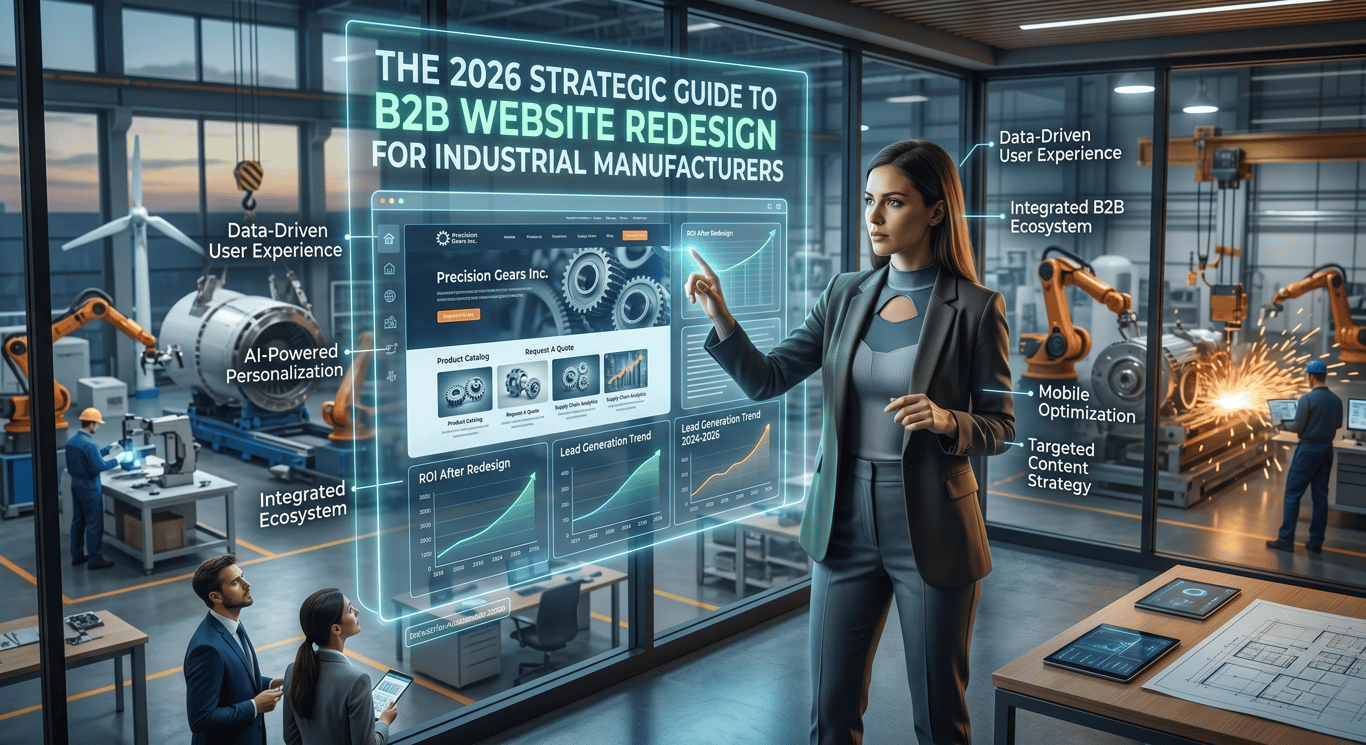
A website redesign for industrial manufacturing in 2026 is not a cosmetic exercise. It is a strategic infrastructure rebuild organised around the following framework:
Pillar 1: Buyer-Segment Architecture
Design the site architecture around buyer segments, not product categories. Create distinct entry paths for domestic enterprise buyers, SME buyers, and international export buyers. Each path should surface the content that is most relevant to that segment's decision criteria: domestic enterprise buyers want quality certifications, capacity data, and production capability; international buyers want export references, compliance documentation, and logistics capability; SME buyers want minimum order quantities, pricing transparency, and responsiveness signals.
This does not require a larger website. It requires a smarter information architecture — one that uses navigation, homepage design, and internal linking to direct different buyer types toward the content most relevant to their decision.
Pillar 2: Technical Credibility Infrastructure
Industrial buyers evaluate technical credibility through multiple signals:
Certification display: ISO, BIS, REACH, RoHS, CE — certifications should be displayed prominently with download links to certification documents, not just mentioned in passing
Manufacturing capability documentation: Machine list, production capacity, tolerance capabilities, quality control processes — presented in formats that a sourcing engineer can evaluate meaningfully
Material and process specifications: Precise technical data that demonstrates depth of expertise, not marketing language
Factory and process photography: Professional, high-resolution imagery of production facilities, quality control environments, and finished products — the single most underinvested element in manufacturing website design
Pillar 3: Case Study and Reference Architecture
Every manufacturing website in 2026 should have structured case studies that document: the client's problem or requirement, the manufacturing solution delivered, the technical parameters achieved, and the measurable outcome. Case studies do not need to name clients if confidentiality is required — they need to demonstrate the pattern of problem-solving that characterises your operation.
Reference architecture should include: an industry sectors served section with specific applications in each sector, a client geography map for export-oriented manufacturers, and a testimonial system that captures the voice of procurement and engineering contacts rather than generic endorsements.
Pillar 4: Commercial Clarity
Remove the friction between buyer interest and commercial engagement. Every product or capability page should answer:
What is the minimum order quantity?
What is the typical lead time?
What is the standard quoting process and timeline?
What certifications and documentation are available?
Who is the correct contact for procurement enquiries?
Manufacturers who hide this information behind a contact form — forcing buyers to enquire before they can evaluate commercial viability — lose buyers who are unwilling to invest sales interaction time in a vendor they cannot pre-qualify.
Pillar 5: Performance and Technical SEO Foundation
A manufacturing website redesign in 2026 must be built on a technically sound foundation:
Performance: Core Web Vitals compliance on mobile and desktop. A manufacturing website serving international buyers on variable connections cannot afford a 6-second load time. Next.js with optimised image delivery and static generation for product pages achieves sub-2-second LCP consistently.
Technical SEO: Structured data markup for LocalBusiness, Product, and Organization schemas. Properly structured heading hierarchies on product pages. Canonical URL management for product variant pages. XML sitemap architecture that prioritises crawl budget allocation toward high-value product and capability pages.
International SEO Foundations: For export-oriented manufacturers, hreflang implementation for multi-language versions, country-specific landing pages for key export markets, and international schema markup are competitive necessities rather than advanced optimisations.
The Content Strategy for Manufacturing Websites
Content is the mechanism through which manufacturing websites generate organic discovery and convert that traffic into qualified leads. The content strategy for a manufacturing website has three distinct layers:
Layer 1: Capability Content Evergreen pages documenting manufacturing capabilities, processes, materials, and certifications. These pages rank for specification-level queries — "investment casting tolerances India," "5-axis CNC machining capability Pune" — and convert buyers who are deep in the research phase.
Layer 2: Application Content Industry-specific pages documenting how your manufacturing capabilities serve specific sectors — automotive, aerospace, oil and gas, consumer electronics. These pages capture buyers who search by application rather than process — "precision components for automotive suspension systems," "custom fabrication for HVAC equipment manufacturers."
Layer 3: Thought Leadership Content Blog and resource content that addresses the questions buyers ask during the research phase: material selection guides, quality standard comparisons, manufacturing process explainers, supply chain risk management perspectives. This content builds organic authority, generates backlinks from industry publications, and positions your company as a knowledge leader rather than just a production facility.
ROI Expectations from a Manufacturing Website Redesign
B2B manufacturing website best practices 2026 implementations typically produce measurable outcomes within 6 to 12 months:
Organic search visibility: 3x to 8x increase in organic impressions for target manufacturing keywords within 9 months of a technically sound launch
Qualified enquiry volume: 2x to 4x increase in monthly RFQ submissions within 12 months, driven by improved discoverability and reduced friction in the enquiry process
International buyer conversion: Measurable increase in international enquiry quality — from generic interest to specification-ready RFQs — driven by improved commercial clarity and technical credibility infrastructure
Sales cycle compression: Buyers who arrive from organic search having read capability pages, case studies, and certification documentation require fewer qualification calls before progressing to quotation — compressing the sales cycle by 20% to 40% in practice
Choosing the Right Web Development Partner for Manufacturing
Not every web development agency has the context to build manufacturing websites that perform commercially. The right partner for industrial website development India should demonstrate:
Experience with B2B buyer psychology and industrial procurement decision processes
Capability in Next.js or React-based development for performance-grade infrastructure
Understanding of technical SEO for manufacturing categories
Ability to translate engineering and manufacturing concepts into commercially compelling web copy
Portfolio of manufacturing or industrial sector clients with measurable performance outcomes
Questions to ask any agency before engaging: What is your approach to mobile performance on manufacturing websites? How do you handle multi-segment buyer architecture? What does your SEO handoff look like at launch? Can you show me a manufacturing website you have built and its organic traffic growth over 12 months?
Final Word
The Indian industrial manufacturing sector has earned its global reputation through engineering excellence, production consistency, and cost competitiveness. In 2026, maintaining that competitive position requires a commensurate investment in digital infrastructure — not because the old relationship-based model is dead, but because the buyers you most want to reach are evaluating you digitally before they ever reach out.
A manufacturing website that reflects the actual quality of your operation is not a luxury. It is the digital prerequisite for the commercial relationships your operation is capable of winning.
Calsinas builds B2B manufacturing website redesigns that translate operational excellence into digital credibility — engineered for performance, designed for conversion, and built to generate the qualified industrial buyer enquiries your sales team deserves to receive.
Talk to us about your manufacturing website.
Calsinas is a web development agency specialising in high-performance B2B websites for Indian manufacturers, exporters, and industrial businesses. We build digital infrastructure that reflects operational excellence and generates qualified commercial enquiries.