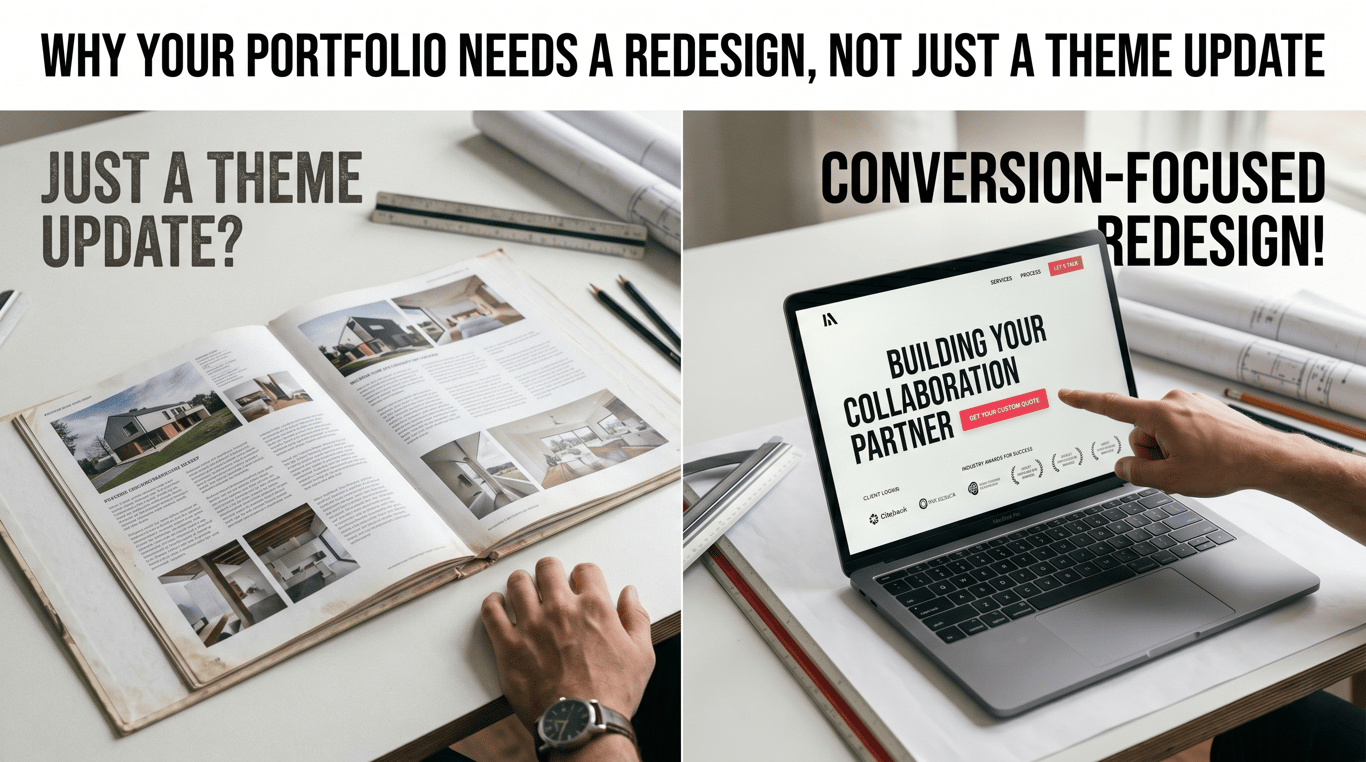
Every few years, an architect or interior designer looks at their website, decides it feels dated, and buys a new theme. New fonts. New colour palette. New homepage layout. The portfolio images get rearranged. The about page gets rewritten. The firm announces a "new website" on Instagram, receives a modest wave of congratulatory comments, and waits for the leads to improve.
They do not improve. Because the problem was never the theme.
The problem is that the website was built as a portfolio — a passive gallery of completed work — rather than as a conversion system designed to turn qualified visitors into active enquiries. Changing the visual wrapper of a passive portfolio produces a newer-looking passive portfolio. The leads remain exactly where they were: absent, inconsistent, or low-quality.
This article is for architects and interior designers who are done changing themes and ready to build something that actually performs. Here is why a conversion-focused UI/UX design agency for architects approaches your website fundamentally differently from a theme update — and what the difference produces commercially.
The Portfolio Website Trap
Architecture and interior design websites have a structural problem baked into their category assumptions. The portfolio website is the industry standard. Beautiful project photography. Project name and brief description. Filter by type. View more. Contact us.
This format makes intuitive sense for the profession. Architecture and interior design are visual disciplines. The work speaks for itself. A curated portfolio of excellent projects should attract excellent clients.
In practice, the portfolio website format fails at conversion for a consistent set of reasons that have nothing to do with the quality of the work displayed.
The Silent Portfolio Problem
A passive portfolio answers one question: "Can this firm produce beautiful work?" It does not answer the questions a client who is actually considering hiring a firm needs answered before they will pick up the phone:
What kind of projects does this firm specialise in? (A firm that has done residential, commercial, hospitality, and institutional projects equally appears to have no specialisation — which is a risk signal for a client who wants a specialist)
What is this firm's design process? How will they handle my project?
What does working with this firm actually cost?
How long will my project take?
Who else has hired this firm for a project like mine, and what did they experience?
What happens after I submit a contact form?
A portfolio that shows ten stunning projects but answers none of these questions leaves the prospective client to research, speculate, and assume — and then, in most cases, to move on to the next option in their search results rather than submitting an enquiry into an unknown process.
The Aesthetic Echo Chamber Problem
Architecture and interior design websites are evaluated by two fundamentally different audiences: industry peers who appreciate design excellence, and prospective clients who are evaluating a service provider. These audiences have entirely different priorities.
Industry peers appreciate spatial composition, materiality choices, technical detailing, and design innovation. Prospective clients appreciate evidence that the firm will manage their project reliably, communicate clearly, stay on budget, and produce a result they will love.
Most architecture and interior design websites are optimised for the industry peer audience — because that audience is vocal, visible on social media, and gives the designer immediate feedback. Prospective clients are quiet. They visit the website, form a private assessment, and either enquire or do not. The designer rarely knows why the ones who did not enquire left.
The result is a website that wins design awards and generates unreliable enquiry volume. The portfolio impresses the peers. The clients go to the competitor whose website was less beautiful but answered their questions more directly.
The Conversion Architecture Void
Most architecture portfolio websites have a single conversion mechanism: a contact form. Submit your name, email, message. Click send. Wait.
This is a single-point conversion system with no qualification, no nurturing, no pathway for different buyer types, and no mechanism for capturing partial intent — the visitor who is interested but not ready to enquire yet.
A conversion-focused UI/UX design agency for architects builds multiple conversion pathways appropriate to different client types and decision stages. The visitor who is ready to enquire has a frictionless contact path. The visitor who is evaluating but not yet committed has a lower-friction engagement option — a portfolio download, a process guide, a consultation booking with clear expectations. The visitor who is early-stage research can enter a content relationship that maintains engagement until they are ready.
A single contact form captures none of the middle-ground intent. It serves only the buyer who is already certain — and loses everyone who needed one more touch before becoming certain.
What a Conversion-Focused Architecture Website Actually Does Differently
Website redesign for interior designers India done with conversion intent looks categorically different from a portfolio refresh. Here is what changes — and why each change matters commercially.
Differentiation of Buyer Segments and Project Types
High-performing architecture and interior design websites create distinct pathways for distinct buyer segments:
Luxury residential clients are evaluating aesthetic alignment, trustworthiness, and process quality. They want to see projects similar to theirs — homes at their budget level, in their design aesthetic, delivered to clients who are recognisably like them. They want to understand what the experience of working with the firm feels like. They respond to empathy, specificity, and social proof from similar clients.
Commercial and hospitality clients are making risk-managed procurement decisions. They want to see relevant sector experience, evidence of project management capability, references from organisations similar to theirs, and clarity about the firm's process for managing complexity. They respond to credentials, case studies, and demonstrated understanding of commercial project constraints.
Institutional and government clients are evaluating compliance, certification, and track record in regulated environments. They have procurement processes and vendor assessment criteria. They respond to formal credentials, completed project specifications, and evidence of regulatory navigation experience.
A portfolio website with a single "Projects" grid serves none of these segments specifically. A conversion-focused architecture website routes each segment to content specifically designed for their decision criteria — because specificity converts and generality does not.
The Process Page as a Conversion Asset
The single most underinvested page on most architecture and interior design websites is the process page. Most firms either do not have one or have a brief, generic "our process" section with four circles and labels: "Discovery," "Design," "Development," "Delivery."
This communicates almost nothing. What it needs to communicate is everything that resolves a prospective client's uncertainty about what engaging your firm will actually be like.
A high-converting process page for an architecture or interior design firm answers:
What happens in the first consultation? Is it free? How long does it take? What should the client bring?
How does the design phase unfold? How many concepts will the client see? How many rounds of revision are included? How are client preferences integrated?
How is the project costed? Is there a fixed fee? A percentage-based fee? A staged payment structure?
Who manages the project day-to-day? Is it the principal architect/designer or a project manager?
What is the typical timeline for a project of each type and scale?
What does the client need to do or decide at each stage?
A process page that answers these questions converts prospective clients who were hesitating not because they doubted the firm's design capability — they could see that in the portfolio — but because they did not understand what engaging the firm would involve.
Social Proof Architecture That Converts
Client testimonials on most architecture and interior design websites are decorative. Three pull quotes in a slider. Generic expressions of satisfaction with no specificity, no context, and no evidence of verified authenticity.
Conversion-focused social proof for architecture and interior design websites has a completely different structure:
Case study format testimonials: Each testimonial is embedded within a project case study — the client's brief, the design challenge, the solution, and then the client's specific words about what they valued about the experience. The testimonial is contextualised by the project, making it verifiable and specific rather than abstract.
Video testimonials: A 90-second video of a residential client standing in their completed home, describing the experience of working with the firm, carries more conversion weight than twenty text testimonials. Video testimonials are rare on Indian architecture and interior design websites — which means the firms that have them own a significant trust signal advantage.
Before and after documentation: For residential renovation and interior design clients, before-and-after photography is among the highest-converting content formats available. A client considering a renovation of a similar property type sees the transformation made possible by the firm's work — turning abstract capability into concrete, imaginable outcome.
Referral and award signals: Award recognition (national or international), press features, and referral source identification ("70% of our residential projects come from client referrals") are powerful social proof signals for high-investment services where peer validation is a significant trust mechanism.
Specific Project Case Studies Over Generic Portfolio Grids
The difference between a portfolio entry and a case study is the difference between showing your work and explaining it.
A portfolio entry: a project name, a category label, and a gallery of beautiful photographs.
A case study: the client's brief and specific challenges, the design constraints (budget, site conditions, client lifestyle requirements, regulatory constraints), the firm's design approach and key decisions, the materials and finishes selected and why, the measurable outcomes (project delivered on time and budget, client satisfaction outcomes, any post-occupancy feedback), and the photography that documents the finished result.
Case studies rank for specific search queries — "luxury villa interior design Lucknow," "office interior design Noida," "heritage property restoration UP" — that portfolio grids cannot target. They provide the depth of evidence that enterprise and commercial clients need before shortlisting. And they demonstrate design thinking — the reasoning behind decisions — that differentiates a firm from competitors who only show outcomes.
For B2B lead generation for architectural firms, case studies targeting the commercial and institutional buyer segment are especially valuable. A corporate headquarters interior design case study demonstrating budget management, stakeholder coordination, and project delivery discipline speaks directly to the concerns of a corporate real estate manager evaluating architectural firms — concerns that no portfolio photograph can address.
The Technical Architecture of a High-Converting Architecture Website
Conversion-focused UI/UX design for architects must be delivered on technical infrastructure that does not undermine the conversion architecture through performance failures.
Image Optimisation for Portfolio-Heavy Sites
Architecture and interior design websites are among the most image-intensive on the web. Professional photography at portfolio-quality resolution results in large files that, managed naively, destroy mobile performance.
Next.js with its native Image component solves this at the architectural level:
Automatic WebP/AVIF conversion reducing file sizes by 40–60% without visual quality loss
Responsive image delivery serving appropriate resolutions for each device
Lazy loading preventing offscreen images from blocking initial page render
Blur-up placeholders maintaining visual layout stability during image load
The result is a portfolio website that achieves Core Web Vitals compliance despite carrying hundreds of high-resolution project images — something that is genuinely impossible on most theme-based portfolio platforms without extensive manual optimisation.
Enquiry Form Architecture
The contact form on a conversion-focused architecture website is not a generic three-field form. It is a qualification and routing instrument designed to:
Identify the project type (residential, commercial, institutional)
Capture the project location
Establish the approximate budget range
Identify the timeline
Collect the specific contact information needed for a meaningful initial response
This information serves two purposes: it allows the firm to prepare a relevant, personalised initial response rather than a generic acknowledgement, and it signals to the prospective client that the firm is serious about understanding their project — not just collecting enquiries.
Conditional form logic — showing different fields based on project type selection — keeps the form concise for any individual client while capturing comprehensive qualifying information across the full range of enquiry types.
Mobile Portfolio Experience
Mobile users evaluating an architecture or interior design portfolio expect a fluid, full-screen image viewing experience. The portfolio browsing behaviour on mobile is fundamentally different from desktop — users swipe through images in rapid succession, pausing when something arrests their attention.
A mobile portfolio experience optimised for this behaviour: full-screen swipe navigation, pinch-to-zoom capability for detail examination, minimal UI chrome that keeps the photography front and centre, and sticky project information (name, category, location) that remains visible during image browsing without obscuring the photograph.
Most theme-based architecture portfolio websites deliver a compromised mobile experience — thumbnail grids that require precise tapping, modal viewers that load slowly, and layouts that prioritise desktop aesthetics over mobile usability. This is a measurable conversion failure: a prospective client who cannot comfortably browse the portfolio on mobile will not enquire from mobile.
SEO Architecture for Architectural Services
Architecture and interior design firms in UP compete for local and national searches with specific geographic and service modifiers. The SEO architecture of a conversion-focused architecture website targets:
Local service queries: "Architect in Lucknow," "interior designer Noida," "architectural firm Agra" — captured through city-specific service pages and localised schema markup.
Project type queries: "Luxury villa architect UP," "commercial office interior design Noida," "restaurant interior designer Lucknow" — captured through project-type case study pages and category landing pages.
Process and cost queries: "Interior design cost Lucknow 2026," "how to hire an architect India," "architecture firm selection guide" — captured through educational content that attracts research-phase clients.
Credential and recognition queries: "Award-winning architect Lucknow," "IIID member interior designer UP" — captured through credential and recognition pages that rank for clients specifically seeking validated expertise.
What the Investment Looks Like and What It Returns
Website redesign for interior designers India at the conversion-focused level represents a fundamentally different investment from a theme update. A theme update costs ₹15,000 to ₹60,000 and produces cosmetic change. A conversion-focused redesign costs ₹1,50,000 to ₹4,00,000 depending on firm size and feature complexity — and produces commercial change.
The ROI calculation for a luxury interior design firm is simple:
A firm billing ₹25,00,000 per year from 8 to 10 residential projects receives an average enquiry value of ₹3,00,000 to ₹4,00,000 per project. If the conversion-focused website redesign generates three additional qualified project enquiries per month through improved SEO visibility and conversion rates — and converts two of those twelve additional annual enquiries — the website has generated ₹6,00,000 to ₹8,00,000 in additional annual revenue. The website investment pays back within six months and compounds thereafter.
The more significant return is qualitative: better-qualified enquiries, higher-budget projects, and a client base that arrived already aligned with the firm's design direction — reducing the wasted time of pursuing projects that were never the right fit.
The Checklist: Signs Your Architecture Website Needs More Than a Theme Update
Your architecture or interior design website needs a conversion-focused redesign — not a theme update — if:
You are getting compliments on your portfolio from peers but not enquiries from clients
The leads you receive are predominantly from the wrong budget range or project type
Your website has no project case studies — only a photography portfolio
You have no process page, or your process page is less than 500 words
You have one contact form and no other conversion mechanisms
Your mobile PageSpeed score is below 60
No new clients have mentioned finding you through Google in the last 6 months
Your website looks the same as 15 other architecture firms in your city
You cannot tell from your analytics which pages are generating enquiries
If four or more of these are true, a new theme will not solve your problem. A conversion strategy will.
Final Word
Your portfolio is not your problem. Your conversion architecture is.
The architects and interior designers who are consistently winning high-value projects from digital channels in India are not those with the most beautiful websites. They are those with websites engineered to take a qualified visitor — someone who found them through organic search, scrolled through their projects, and felt the first spark of interest — and systematically convert that interest into a phone call.
Conversion-focused UI/UX design for architects is not about making your portfolio less beautiful. It is about making it work harder — answering the questions your clients are actually asking, routing different client types to the evidence they need, and making the decision to enquire feel easy, obvious, and risk-free.
Calsinas builds conversion-focused architecture and interior design websites on Next.js — engineered for performance, designed for your buyer, and built to generate the quality of client enquiries your work deserves.
Let us redesign your portfolio for performance, not just presence.
Calsinas is a web development and conversion optimisation agency building high-performance websites for architects, interior designers, and professional service firms across India.